The breakwater connecting Moda Pier to the shore seems almost as if it were built to carry your steps toward entirely different beauties. As you walk along it, the insatiable mystery of Kalamış Bay on one side and the fierce lodos winds of the Marmara Sea on the other draw you into an indescribable excitement. But beware—do not stop and look back by mistake! You cannot help but shudder. The building behind you, resembling a small, eerie castle straight out of a horror story, appears as though it is fixing its angry gaze upon you.
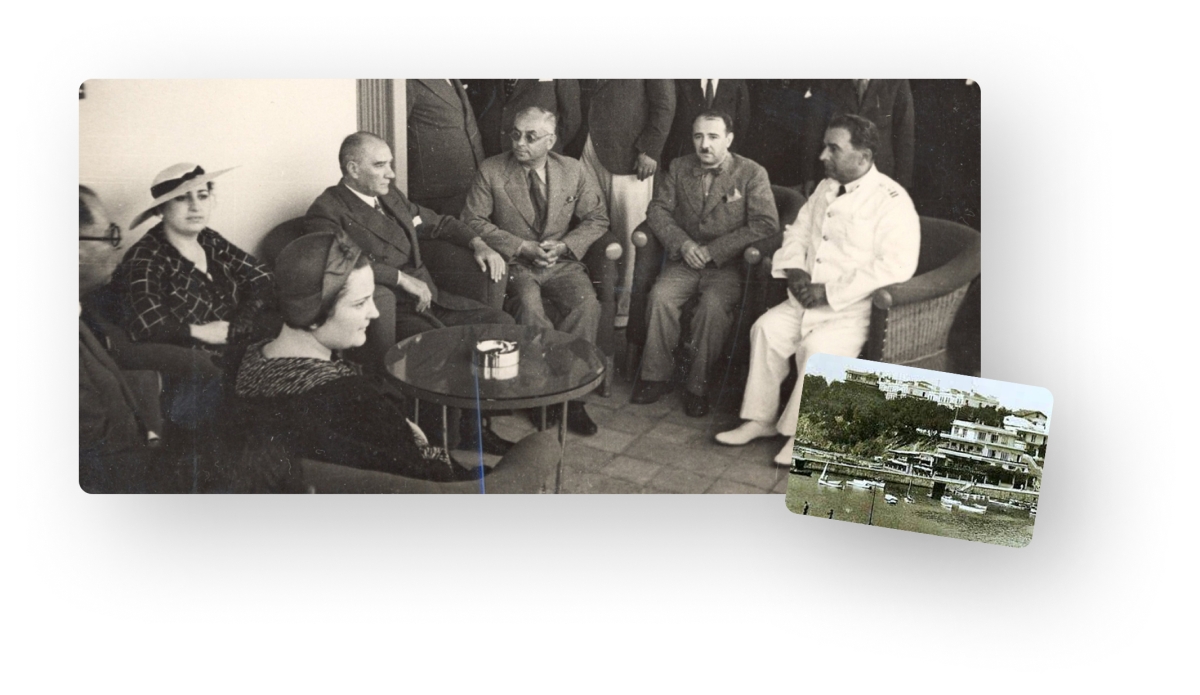
And how could it not be angry? Today its windows are broken, even the roots of the ivy that once embraced it have long since turned to soil, and its beautiful door—now warped and on the verge of collapse—once welcomed so many distinguished guests. Kings, queens, and great statesmen all entered through that wide doorway and were hosted within. Who knows what Atatürk spoke about to those around him as he sipped his coffee on the once-grand upper terrace on the second floor, now with peeling plaster and the caretaker’s laundry fluttering in the breeze? On the shabby lower summer terrace stretching toward the sea—now pockmarked with large holes—you can almost still hear the whispers of dancing couples. How many pure loves blossomed during Thursday tea times and youth evenings? From the boats moored side by side in the waters between the pier, the matchless voice of Münir Nurettin would softly embrace the bay, becoming an inseparable part of moonlit nights. Groups of elegantly dressed people would stroll down to the pier to watch these scenes, becoming almost inseparable from the very spirit of the building itself.
Today, none of that beauty remains. Those who do not know its past often ask, “What on earth is this ruin?” You avert your eyes in embarrassment and try to change the subject. To say, “It used to be the Moda Club,” surely pains your heart.
Most of what we are about to recount—indeed, the very roots of these stories—took place within this building. From yesterday to today, the memories of Moda Deniz Kulübü have always found their home here.
Today, when we speak of the “culture” that forms Moda Deniz Kulübü, any words uttered without knowing or understanding the past will remain hollow. Why was the Club founded here? To what extent did the Club and its surroundings influence one another? Or does the word “Moda” in our name merely indicate the district where the Club is located? Let us now take a short journey into the past together. Even if we cannot relive each beautiful day one by one, let us try to recall them as a whole and seek answers to these questions.
The founding date of Moda Deniz Kulübü is April 8, 1935. The order for its establishment was given by the Great Leader Atatürk. In nearly all books written about the founding of the Club, it is stated that: “After the War of Independence, when Atatürk visited Istanbul for the first time in 1927, he toured Moda Bay aboard the Ertuğrul Yacht and saw the Yacht Club founded by English families living in Moda. He received information about the Club and its activities from those around him. In later years, with the support of Celal Bayar—who would become the first President of the Club—he expressed his wish that Turks should also establish a similar club.”
However, in our view, the matter is not quite so simple. Atatürk did not act out of a superficial thought such as, “If the English have a Yacht Club, why shouldn’t the Turks?” The Great Leader, who examined every decision in depth and ultimately pointed to the most accurate course of action, could never have approached this issue impulsively or emotionally. On the contrary, with the founding of the Republic, he wished for the people of this country—who were opening all doors to modernity—to reflect the same spirit in their way of life. When the Republican Reforms and the social principles underlying them are closely examined, it becomes clear how powerful the efforts were to entrench these transformations.
The instruction to establish Moda Deniz Kulübü is one such meaningful example of these efforts. Therefore, the choice of Moda as the location for the Club was by no means a coincidence or a spontaneous decision. Otherwise, the empty shores of Kalamış or Fenerbahçe could easily have been preferred at that time.
Kadıköy—and particularly Moda—has long been one of our foremost districts, hosting deep-rooted cultures throughout history. We believe that Atatürk wished for the Club to grow and flourish upon such a cultural foundation and to serve as a model. To support this view, it is worthwhile to take a closer look at Moda and its surroundings.
When we open the window of history slightly, we see that Kadıköy and Moda are among the oldest settlement centers of Istanbul. According to a well-known legend, around 660 B.C., the people of Megara, seeking a new homeland, consulted the Oracle of Delphi, who instructed them to “settle opposite the land of the blind.” The group led by Byzas interpreted this to mean the area across from Chalcedon (Kadıköy) and thus settled on the Sarayburnu side, founding Byzantium.
Thus, according to legend, the name of the region where we live today was determined in this way. If we were to playfully reinterpret the legend, one might say that had Byzas first come to Kadıköy and watched the sunset over Sarayburnu from this side, he might well have called those on the opposite shore “the blind ones.”
In reality, historical sources confirm that life in this region developed from Kadıköy toward Sarayburnu beginning in the late second millennium B.C. Kadıköy existed long before the founding of Byzantium. It is said that Emperor Theodosius had a palace on Herueon (Moda Cape), one of Chalcedon’s three promontories. Around 658 B.C., Phoenicians settled along the coastline between Moda Cape and what is now Yoğurtçu Park. According to one view, the Phoenicians named Kadıköy “Chalkhedon,” meaning “New City.”
At that time, Moda served as a Phoenician trading pier. Archaeological findings in the area—such as ancient tools and artifacts—indicate that this region has been inhabited since antiquity. Excavations at Moda Cape uncovered clay lamps, colored vases, a bull statue, and a bronze tablet bearing the inscription of Chalcedon. As we turn further pages of history, we see that the Umayyad commander Khalid bin Zayd arrived in Chalcedon in 688 A.D., and that the Abbasids settled here in 781 A.D. In 133 B.C., King Attalus of Pergamon incorporated Chalcedon into the Roman Empire. The Ottomans settled in Kadıköy in 1350, and with the conquest of Istanbul by Fatih Sultan Mehmet, the eastern and western sides of the city were united under Ottoman rule.
The years following the Tanzimat Reform of 1839 marked a period in which Western culture increasingly influenced social life. Living and behaving like Europeans gradually spread from Beyoğlu to the Bosphorus shores, and from there to Moda and the Princes’ Islands. Before long, Moda became a center of this new lifestyle. The introduction of electricity and gas, along with Western architectural styles, naturally transformed the behavior and way of life of its residents. By the 1880s, British, Italian, and French families—alongside established Turkish residents—had created a cultural mosaic in Moda.
These Levantine families, as they were called, played important roles in the commercial life of the era. They lived in Moda and worked in Galata. For example, the palatial wooden mansion built by the Tubini family was so influential that Moda Cape was for a time even known as “Tubini Quarter.”
In addition, families such as Frederici, Momiko, Lafontaine, Loranda, Fürstenberg, and Frankenstein fostered a deep cultural heritage in Moda. The mansions that shaped the district’s architectural character gave the neighborhood a unique beauty. Among the most notable were the Mermer Konak, Whittall Mansion, Mahmut Muhtar Paşa Mansion, the Tubini Mansion (later known as Moda Palas Hotel), Dr. Antipa Mansion, Sabur Sami Bey Mansion, the Dowson Houses, Villa Longchene, Villa Mathieu, Villa Wohl, Villa Charneaud, Villa Landgrabe, Villa Glavani, Dr. Arif Sarıca Paşa Mansion, and the Frederici Mansion. Sadly, most of these beauties have disappeared over time, forced to give way to unplanned urban development.
Among the members of the first Board of Directors of Moda Deniz Kulübü were Arthur Whittall and Reginald Whittall, whose family had also settled in Moda during those years. In the following years, Moda additionally became a refuge for many scholars fleeing the regimes of Mussolini and Hitler.
This diverse yet culturally cohesive structure gradually shaped a distinctive way of life in Moda. In social life, people’s daily attire, manners, and lifestyles presented an appearance quite different from the ordinary. For example, while tennis was almost unknown at the time, the tennis court that today operates within our Club was built in the 1930s under the leadership of English families. During that period, the English organized tournaments at the Moda Tennis Court with rival teams from İzmir and Bebek. It is said that Hazel Whittall, the wife of one of our former presidents, Zeki Rıza Sporel, became champion many times in women’s tennis.
It was during these years that the Yacht Club established by the English at Moda Pier later became known as the “Turkish–English Yacht Club” as Turks began to participate in maritime activities. A 1913 issue of a naval magazine described the sea festivities of that year—attended even by Sultan Mehmet V Reşat aboard the Ertuğrul Yacht—in a richly illustrated sixteen-page article published in Servet-i Fünun Magazine. In this respect, Moda Bay became a meeting point for numerous local and foreign clubs and organizations involved in yachting and other maritime sports, as well as for many renowned yachtsmen.
As can be seen, Moda in those years bore little resemblance to other districts of Istanbul. Women strolling through its streets wearing hats considered unusual for the period, gentlemen drawing attention with distinctive attire, and a lifestyle far from conventional all served as striking examples of this uniqueness. In fact, the very name “Moda” was given to emphasize this difference. Sami Paşazade even refers to Moda Cape in his novel Sergüzeşt, indicating that the name “Moda” dates back to as early as the 1880s.
With the proclamation of the Republic in 1923, the modern structure and mentality created by successive reforms settled effortlessly into the lifestyle already present in Moda. During this period, many prominent Turkish families chose to settle in this district, turning Moda into a symbol of diversity and cultural richness.
Therefore, when our founder Atatürk gave the instruction—upon Celal Bayar’s suggestion—to “establish a Turkish club as well,” the primary objective was undoubtedly to engage in maritime and yachting activities. However, sustaining such activities required a cultural foundation. Moda’s modern character and its inclination toward such sporting initiatives were at least as influential as the initial aim.
Institutions live in close connection with their surroundings and the individuals who form them. It is the worldviews and social outlooks of these individuals that give life to an institution, shape it, and define its spirit. This structural unity gains color through the influence of the social environment in which it exists and creates its own unique character. Likewise, processes of change evolve as similar factors themselves transform. For this reason, the inclusion of the name “Moda” at the beginning of our Club’s name was not intended merely to indicate its location—as is the case with many institutions—but rather to express a cultural unity with the district itself.
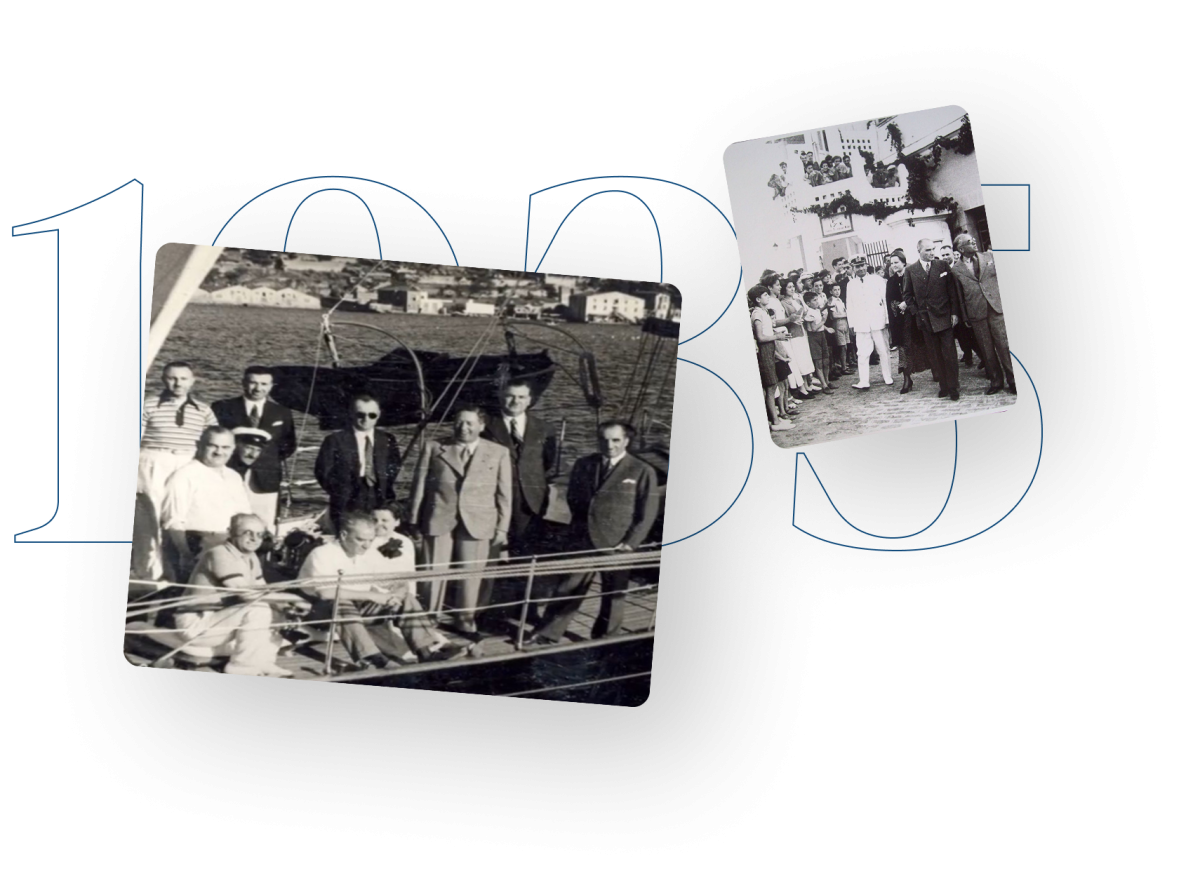
Recognizing this distinctive quality, Atatürk wished for the Club to be founded upon such a cultural foundation and to stand out with this identity. His frequent visits to the Club and his reception there of King Edward VIII of England—who came to Istanbul aboard the Nahlin Yacht the very year after the Club’s founding—are events that clearly support this fact. Furthermore, Atatürk’s hosting of King Carol of Romania and many other statesmen at the Club during his short lifetime should not, in our view, be regarded as mere coincidence.
After being established with these objectives, the Club has expanded over the years with respected members from every region of Istanbul and our country. Integrating their cultural richness, it has attained the exemplary position it holds in society today.
From this perspective, Moda Deniz Kulübü should be seen as a union formed by individuals who embraced modern, pluralistic values in a district that had opened its doors fully to the West. Within it, one can trace the influences of Ottoman Istanbul, the Tanzimat era, and the Levantine culture of Moda—but above all, the enthusiasm of the Republican Reforms. The members’ outlook on life, their manner of conduct, and their contemporary mindset have proudly carried this institution to the present day. In other words, at the very core of Moda Deniz Kulübü’s foundation lie libertarian thought, a modern way of life, and an unwavering commitment to the ideals of the Republic.
Establishment
Having experienced the beauty of Moda and Kalamış Bay, Atatürk, while also considering the social and cultural fabric of the area, instructed the then Minister of Economy, Celal Bayar, to establish the Club in the autumn of 1934. Following this directive, Celal Bayar and Zeki Rıza Sporel came together to initiate the preparatory work. Muvaffak İşmen, Deputy General Manager of İş Bank, and Fazıl Öziş, the first name on the membership list, joined the founding team, intensifying the efforts.
Two alternative models for establishment were considered: either to create a club entirely independent of any institution, or—as previously mentioned—to form it in conjunction with the existing Turkish–British Yacht Club in Moda. The second option prevailed. This decision highlighted the desire to engage in water sports, particularly yachting. Supporting this approach were Celal Bayar’s yacht Umurbey, Refii Bayar’s cutter Yıldız, usually anchored in Moda Bay, and Zeki Rıza Sporel’s boat Ceylan. Additionally, the Whittall family’s yachts and dinghies, already moored in the bay under the Turkish–British Yacht Club, reinforced the necessity of a merger. Contact was immediately established with the existing Club, which welcomed the idea with enthusiasm. Since the majority of members were already Turkish, merging resources and objectives into a stronger institution was deemed far more prudent than operating side by side.
By winter, the membership list of 64 individuals was nearly complete, and legal formalities were underway. As the Associations Law had not yet come into force, the Civil Code’s provisions on associations were utilized to draft the founding charter. Naturally, the statute emphasized maritime and yachting activities, making them the central purpose of the Club.
Financing was provided by İş Bank, with Celal Bayar’s influence as one of its founders playing a significant role. The involvement of Muvaffak İşmen and Fazıl Öziş, both Deputy General Managers of the bank, further strengthened its support. Zeki Rıza Sporel, meanwhile, was managing the Istanbul representation of the Wool Industry Factory, a subsidiary of the bank, together with Mahmut Baler. İş Bank’s financial contribution of 30,000 lira—a substantial sum at the time—greatly facilitated the process.
There was no issue regarding premises. Since 1910, the Turkish–British Yacht Club had operated at Moda Pier, occupying a reinforced concrete building constructed by Cevdet Tahir Bey, son of the Governor of Van, Tahir Pasha, on land previously used as a timber depot. Situated directly on the waterfront, the building’s architecture and location gave it the appearance of an impressive yacht club. Unfortunately, the newly established Club also moved in as a tenant, a status that persisted for many years.
Ownership of the building later passed to Celal Sofu, who served on the Club’s board. He and his wife, Melek Hanım, resided on the upper floor while leasing the lower floor as a café. Upon his death, three-quarters of the property was inherited by his son, Ziya Sofu, and one-quarter by his mother, the painter Melek Celal. Following Melek Hanım’s death in Germany in 1976, Ziya Sofu became sole owner. As will be discussed later, due to disputes with the Club, he sold the building in 1980 to Son Oto Trading and Industry Inc., owned by Mustafa Özkan. Today, the building belongs to a private individual.
The construction of the boathouse adjacent to the old building occurred in later years, after the Club’s establishment. Previously, during the Turkish–British Yacht Club era, a makeshift shed covered with wooden planks had served for boat maintenance. It was reportedly operated for a time by the Tanyaş family. The boathouse commissioned by the Club and managed by Ahmet Reis, however, was purpose-built and far superior in function.
Regrettably, despite the building changing hands multiple times, Moda Deniz Kulübü never asserted ownership by declaring, “We will acquire the building.” Had the leadership shown such determination, many of the serious difficulties encountered in later years could likely have been avoided, and perhaps the Club’s destiny would have taken a different course.
Returning to the founding efforts: among the initial founders were Reginald Whittall, Arthur Whittall, and Arnold Haendel, administrators of the Turkish–British Yacht Club. The intention was to benefit from their experience in club management and yachting. On April 8, 1935, the founding charter was registered and announced, with the following individuals comprising the founders and board of directors:
Celal Bayar: Member of Parliament for İzmir, Çifte Havuzlar
Reginald Whittall: Merchant, Kadıköy Devriye Street
Fazıl Öziş: Deputy General Manager, İş Bank, Ankara
Muvaffak İşmen: Deputy General Manager, İş Bank, Ankara
Arnold Haendel: Deutsche Orient Bank, Istanbul Branch Manager
Zeki Rıza Sporel: Wool Industry Factories, Istanbul Agency, Frederiçi Apartments
Arthur Whittall: Head of Passport Department, British Embassy
The founding charter registered the name as Moda Club. Article 1 stated: “The association established under this charter, accepted by and registered with its members, aims to expand social relations, meet social needs, and engage in all forms of water sports. Its name shall be Moda Club.” For many years, the institution was thus known as Moda Club.
At the first board meeting, members honored Atatürk’s directive by unanimously electing Celal Bayar as President, recognizing his significant contributions. At the subsequent general assembly, İsmet İnönü was enthusiastically accepted as Honorary President, marking the Club’s official beginning.
By year’s end, membership had reached 192. Although documentation is lacking to identify all early members systematically, unlike the Turkish–British Yacht Club, Moda Club’s membership extended beyond local residents, encompassing prominent figures from both Istanbul and Ankara.
The excitement was immense. The board, emphasizing yachting, organized exemplary events. The pier was enlivened with colorful yachts, and the thrill of competitions attracted great public interest. Crowds gathered along the Moda Pier breakwater, in front of Koço Café, and on the seaside cliffs to enjoy the spectacle.
Moda Club quickly became a focal point of social life. Such was the enthusiasm that Hayri İpar donated his famous yacht, built in Southampton in 1903, to the Club. He was followed by Refii Bayar, who gifted his cutter Yıldız, and by the National Textile Factory, which donated the Emek and Yazgan motorboats. The excitement continued with Celal Bayar’s donation of the Bayar I and Bayar II motorboats. In the early 1950s, Fuat Süren further strengthened the fleet by donating the yacht Flamingo.
Witnessing this wave of generosity, other members organized a campaign, pooling funds to purchase the cutter Rüya and the motorboats Refuge and Rüzgar for the Club.
Development of Moda Club
The development of Moda Club in this direction continued for many years. To instill sailing sports among its members, Harun Ülman was provided with the yacht Martı, as well as the large cutters numbered 1 and 2, two medium cutters, and two Olympic-class boats, all constructed in the shipyards of the Maritime Administration. The cutters numbered 1 and 2 were without cabins, while the motorized cutter numbered 6 was equipped with a cabin.
Looking back today, one cannot help but be astonished. Such a spirit of trust, enthusiasm, and commitment was created that members donated their yachts and motorboats to the Club without hesitation, and even gathered funds collectively for this purpose. This was not only the behavior of the members; the entire local community found itself swept up in the wave of excitement. Each event was closely followed, and the people of Moda lived these beautiful days intertwined with the Club. The emotional bond that people held seventy-five years ago should serve as an inspiring example to counter the indifference we often lament today.
The opening ball was held magnificently on July 9, 1935. The Great Leader himself honored the evening. Distinguished figures of the state, prominent personalities from Istanbul and Ankara, and members celebrated this important step with elegance and enthusiasm.
Atatürk also attended the sailing races organized by Celal Bayar on August 9, 1936. A month later, on Sunday, September 6, accompanied by King Edward VIII and Madam Simpson aboard the yacht Nahlin, he returned to the Club, watched the races, and later transferred to the yacht Ertuğrul to travel with his guests to Florya. The invitation sent to members for that day’s races included the phrase: “Under the High Patronage of our Great President İsmet İnönü, our Club will organize the Grand Sailing Races in Moda Bay on Sunday, September 6, 1936…” This remains a cherished memory symbolizing unity and solidarity.
On July 1, 1937, the Great Leader attended the Cabotage Day celebrations and the races organized for the occasion aboard the motorboat Acar. He congratulated the winners, and the excitement of the young men receiving medals from Atatürk was unforgettable. Twenty-four days later, he returned to the Club aboard Ertuğrul, before continuing on to the Princes’ Islands and Büyükdere. Again, on August 8, 1937, Atatürk arrived in Moda aboard Ertuğrul, disembarked, and rested briefly at the Club. Sadly, this visit was the last time members and admirers were able to host him at the Club. How we wish his health and life had permitted him to be proudly welcomed for many more years at the institution he founded.
Article 3 of the Club’s charter emphasized the maritime initiative: “The purpose of the Club is to provide the necessary facilities and venues for members who wish to engage in all forms of sports, particularly water sports, and to meet the social needs of its members as a social institution.” As is evident from the founding charter, the Club’s primary field of activity, and indeed its foremost purpose, was water sports and yachting. In line with this, sailing remained the daily pursuit of the Club until approximately 1955. Nearly all members participated in maritime activities. For this reason, when documenting the Club’s history “from past to present,” it is fitting to dedicate a separate section to its nautical heritage, with detailed recollections of yachting to be shared later in the book.
Management and Subsequent Years
The administration under President Celal Bayar continued until the general assembly held on June 23, 1939. In 1937, Bayar’s appointment as Prime Minister inevitably required him to withdraw from active management, though his interest and connection to Moda Club remained constant.
The founding years and those immediately following were filled with enthusiasm, yet also with challenges. The first task was to organize and refurbish the Club building. That charming building, now sadly abandoned and in ruins, bore witness to nearly half a century of significant events that entered history.
To recall those days, let us turn to the vivid account of Mehmet Baler, who lived through much of the Club’s past:
*“On the ground floor of the Club, there was a grand entrance and foyer for its time. Through a vine-covered pergola, one entered a double-winged wooden door with glass panels, presenting a distinguished appearance. Above it, in large navy-blue letters, was written ‘DENİZ KLÜBÜ.’ Perhaps because the word ‘club’ was borrowed from English, the letter ‘u’ after ‘k’ was dropped in the spelling.
Esteemed visitors were welcomed through this door. Atatürk greeted and bid farewell to King Edward VIII here, and King Faisal of Iraq, as well as Shah Reza Pahlavi of Iran and his wife Soraya, were received through this entrance. At dinner, when Shah Pahlavi invited Queen Soraya to dance, we too immediately joined the dance floor, eager to see the royal couple up close.
At the door stood Aziz, the doorman, brother of waiter İsmail. His son Ali later worked at the Club as a waiter and head server. Inside, to the right was the cloakroom, where Aziz hung coats; it also served as a storage for cigarettes and liquor. To the left was the management office, a small room where the Club’s Director, Fenerbahçe’s legendary player Galip Kulaksızoğlu, accountant Mr. Hırant Küçükyan, and secretary Turgut Atakartal worked. Kadıköy’s well-known character, Kavanoz Turgut, close friend of Galatasaray’s goalkeeper Kova Osman, also worked there. A narrow staircase led from the office to a tiny mezzanine room, Galip Bey’s residence, where he slept on a portable camp bed. After his passing, Hidayet Fuat Tugay became the Club’s Director.
The large hall on the ground floor featured a wide staircase with polished wooden railings descending from the mezzanine, and glass doors opening onto the terrace. The floors were European mosaic tiles, faintly shining, with dining tables arranged across the hall. At the far end stood a large bar counter, painted dark brown, managed by Hamparsun Patladanyan, whose demeanor hardly suited that of a bartender. The cold buffet was run by Aleko, a former stalwart of the Kadıköy football team, who also joined long boat trips as both cook and athlete. The Club’s chef, father of Viktor from Ada Furniture, prepared excellent meals—today’s eggplant salad recipe is said to have originated from him.
The Club’s collector, Mithat Efendi, spent his days visiting members door-to-door across Istanbul to collect dues, returning exhausted in the evenings to the Club. With limited space, he sometimes sat in the cloakroom, sometimes beside the telephone booth, or near the terrace doors, waiting to intercept indebted members. Waiter Mehmet Ali was an intriguing figure: an Arab from Beirut who had fled Egypt during the war. Fluent in English, French, Arabic, and several other languages, he resembled a refined Southern European diplomat more than a waiter. He meticulously followed the instructions of Madam Hazel, wife of Zeki Rıza Sporel, regarding table arrangements and service. Alongside him worked the diligent waiter Remzi and the busboy Hakkı.
The Club’s accountant, Mr. Küçükyan, was also a member. His wife, Madam Küçükyan, always sat at the same table on the terrace, calling out to the busboy: ‘Haki! Bring me green beans in olive oil!’
The ground floor terrace, once overlooking the sea, had dining tables and a dance floor, with a small pier accessible by a few steps. Later, due to lack of space, the shoreline was filled in to create a lower terrace, with more tables and a proper quay for boats. Raft’s rowboats departed from this pier. Guests reserving tables for dinner preferred the covered upper terrace, protected from dampness, while latecomers had to settle for the open lower terrace.
During summers, evenings and Sunday afternoons featured live music. Initially, local musicians were hired, but with the rise of Latin music and improved resources, foreign orchestras were engaged. Among them, Spanish musician Romero and Italians Renzo and Corradi won the admiration and affection of many members and their spouses.”
After the 1950s, the lower floor of the Club during the summer months began to be managed by Süreyya, who operated a distinguished social venue in Ankara, together with Russian maître d’hôtel Serj Homyak, formerly of Karpiç. Thanks to them, the Deniz Kulübü downstairs restaurant became one of the most popular and sought-after refined venues in Istanbul. The dîner dansants organized for the opening of the season and the summer balls became legendary. Before these events, the terraces would be meticulously cleaned, tables carefully arranged, and Süreyya would personally powder the dance floor so that people could dance comfortably. Many guests would follow maître d’hôtel Lefter in hopes of securing a good table. Ladies prepared for these invitations days in advance, having special dresses sewn by Istanbul’s finest tailors.
The Club’s delicious pickled cucumbers, like its famous parfaits, were also a legacy left to us by Süreyya. After the grill used in the kitchen was extinguished in the evenings, he would place a tin can filled with cucumbers prepared in brine according to his own recipe over the warm ashes and leave it there overnight. The next day, those wonderfully tender pickles, made slowly in low heat, would be served at the tables. Through the Club, Süreyya became a true resident of Moda. In the early years he stayed at the Moda Palas Hotel; later he bought an apartment in the Marmara Apartment building behind us and eventually opened a restaurant above the BP station in Bebek, which he ran until he passed away. He contributed greatly to the Club. May he rest in peace.
The concerts given by Münir Nurettin at the Club on summer evenings were artistic events in their own right. Münir Nurettin, his wife Enise Hanım, and their daughter Meral would stay during the summers at the Moda Pansion behind the Club. Enise Hanım used to call out to him at the Club with a loud “MUNİİR!”, yet everyone else continued to address him as Münir Bey. Having once played left wing alongside Zeki Rıza Bey on the Fenerbahçe football team, he was a close friend of his. He spent most summer days at the Club in Moda with his family. At that time, he had not yet founded the Kalamış Club in Fenerbahçe.
Concert nights were usually scheduled on full-moon evenings—especially in July and August. On those nights, people who came from outside the Club to listen to Münir Nurettin would completely fill the Moda Pier and the small bay between the pier and the Club with their boats. There would be no room left to stand on the ferry pier. Throughout the concert, which echoed across the entire Moda Bay, not a single whisper would be heard.
Games were played on the middle floor of the Club. As children of members, we were not allowed to enter the game hall. However, in the early years of the Club, children’s balls were organized in the middle hall on Christmas, New Year’s, and Easter—an English tradition carried over from earlier times. On December 24, a large Christmas tree would be decorated with all kinds of ornaments and lights, and beneath it lay beautifully wrapped presents bearing the names of each participating member’s child. While playing musical chairs or taking part in various competitions, we would constantly glance at the gifts under the tree, trying to guess what ours might be. Eventually we would gather around a large table filled with biscuits, pastries, cakes, and treats, drink our tea or milk coffee, and finally it would be time for the presents. A young lady from the Whittall family—usually Hazel (who had not yet married Zeki Bey), and sometimes her sister Irene—would read out our names one by one and distribute the packages. Meanwhile, we would blow whistles, put on pointed gilded hats and paper crowns, throw confetti and streamers, and shout with excitement.
A few times, costume balls were also organized for children. On one occasion, my cousin Sermuş, three years older than me, dressed as Snow White, and I became one of the Seven Dwarfs. Special costumes were sewn from colorful fabrics purchased at Asadur in Kadıköy, including slippers and hats. Fake mustaches and beards were arranged, and we even fashioned a crown for Sermuş. We won first prize. Anahit, the daughter of Küçükyan and about our age, had come dressed as Madame Pompadour. They had worked on her costume for days—it was truly magnificent: a Louis XIV–style queen’s dress of white satin with a tight waist and a huge bell-shaped skirt reaching the floor, curly blond wig, striking makeup, and beauty spots—and yet she did not win!
Madame Küçükyan was furious; she scolded the jury and shouted at us. Perhaps she was right, but what could we do? We were bewildered. The ball ended, and we had to leave early, unable to fully enjoy our victory. We went to Servantis to have a black-and-white postcard photograph taken as a keepsake. In those days there were no roaming photographers at balls, nor any color photographs. Thus, the middle hall of the Club often hosted such useful and joyful days for us children.
At the Club’s upper entrance stood the doorman Ali—always neatly dressed, well-built, and courteous. He recognized every member who came and went to play games. Many members, regardless of weather or time of day, would leave through that door to go home by taxis driven by Necati or Kemal Efendi, or to walk to the tram stop. After all, in those days, few people owned cars.
Most people preferred to reach the Club via Devriye Street along the flat road rather than climbing the hill, entering through the upper door. This door was not as grand as the main entrance—just a simple single-leaf iron door with ribbed glass—but it served at least ten times as many people as the lower entrance.
The Club also had a third, top floor. When first opened and during the war years, it was quite socially active. There were large comfortable armchairs and sofas around a fireplace, as well as a billiard table. The rack holding the cues, the semicircular score indicator in the middle with numbers, and the wooden scoreboard operated by pushing with a cue were all part of its character. When billiards were not being played—or rather, when Mr. Novotni was not present—the table would be covered with current issues of the foreign press: Illustrated Times, The Punch, Time, The New Yorker, Signal, Paris Match, and others. Members who came to the top floor would read them attentively, and during the war these publications often sparked heated and passionate debates between those supporting the Allies and those favoring the Axis powers.
For a period, the third floor was turned into a kind of nightclub where Sakallı Peres and drummer Zareh—musicians we knew from the performances downstairs during the summers—would play. The venue served only drinks and refreshments, without offering food. Although some young people like us showed interest in going there to dance, it closed down after a short time. Thus, the third floor, which had drifted away from its original purpose, was abandoned to its fate. Later on, it began to serve those who played bridge. Yet in the years following the Club’s founding, people who were not necessarily involved in sea sports, who did not constantly play games, or gather around the bar to drink, would also come to the third-floor hall—simply to meet friends at the Club, to chat after work in the evenings or on Sunday mornings, and to enjoy the comfort of being together.
Yes, we listened to Mehmet Baler recount the memories of those beautiful days spent in the old Club building—days that still remain vividly alive in our minds, even though today we are almost afraid to enter that structure, which from a distance grows ever more haunting and sorrowful with each passing day.
“AN OPPORTUNITY”
Returning to where we left off, there have been significant turning points and milestones in the Club’s history up to the present day. Although a small number of these developments resulted in success, many unfortunately ended negatively and generally brought serious difficulties for the Club. Here, we would like to share with you an event from that period that is perhaps unknown to many.
In the second year of our establishment, when everything was progressing with extraordinary excitement, an important opportunity suddenly presented itself to the Club. After one of his visits to the Club, our founder Atatürk, in conversation with our President Celal Bayar, spoke of the necessity of allocating a portion of the treasury-owned lands along the Fenerbahçe and Kalamış shores to the Moda Club. Atatürk envisioned the entire Kalamış Bay being dedicated to maritime sports. Indeed, upon returning to Ankara, he issued a written directive to the Ministry of Interior, expressing “his desire that the breakwater be repaired and that Fenerbahçe be made a center where young people can engage in sea sports,” and instructed that the necessary procedures be initiated.
Following this request and order from Atatürk, the Ministry of Interior prepared a draft decree and submitted it to the Council of Ministers on 29 December 1936, with reference number 87/4964. The proposal concerned the transfer, free of charge, of the treasury-owned portion of the land in question to the Istanbul Municipality in accordance with Article 8 of Law No. 2290, and the leasing of part of this land by the Municipality to the Deniz Kulübü. The sample decree stated, verbatim, that:
“…since Fenerbahçe in Istanbul has long been a recreational area and, according to the approved urban development plan, requires organization and improvement, it is deemed appropriate, pursuant to Article 8 of the Building and Roads Law No. 2290, that the land be transferred free of charge to the Istanbul Municipality with all its rights and obligations, and that a portion of it be leased by the Municipality to the Deniz Kulübü… and that this matter be submitted for the approval of the Council of Ministers.”
Upon receipt of this proposal, the Council of Ministers issued Decree No. 2/8236 on 22 February 1938, which was subsequently approved by President Atatürk. The decree reads as follows:
“Decree of the Council of Ministers dated 22/2/1938 and numbered 2/8236:
This matter was discussed at the meeting of the Council of Ministers held on 22 February 1938, and it has been approved, in line with the opinion of the Ministry of Finance, that the portion of the Fenerbahçe Recreation Area in Istanbul belonging to the Treasury be transferred free of charge to the Istanbul Municipality in accordance with Article 8 of the Building and Roads Law No. 2290, and that a part of this area be leased by the Municipality to the Deniz Kulübü.
President of the Republic
K. Atatürk
Official seal and signature.”
On May 30, 1938, the Ministry of Interior communicated its decision to the Governor and Mayor of Istanbul. On June 6, 1938, experts were instructed to designate the site to be allocated to the Maritime Club, and the matter was referred to the Directorate of Legal Affairs for the execution of title deed procedures in accordance with the directives of the Presidency.
However, this clear decision in favor of Moda Club unfortunately dissolved within the machinery of bureaucracy. Was it that the Club’s management later lost interest in pursuing such an opportunity? Or did certain bureaucratic circles oppose the Club’s settlement in these premises? Or was it simply general indifference that caused the opportunity to slip away? We cannot know for certain. What is clear, however, is that the expansion of Moda Club, particularly in the field of maritime activities, was effectively obstructed at that time.
Had this opportunity not coincided with the period of Atatürk’s deteriorating health, the outcome would undoubtedly have been different. If the decision had been pursued, the Club could have acquired significant facilities on the opposite shore dedicated to sailing and maritime sports, sustaining these activities to the present day. Sadly, the opportunity was missed. In 1952, the establishment of the Istanbul Sailing Club and other sports clubs in the area compensated for this loss through their sailing and rowing activities.
The shock and grief of Atatürk’s untimely passing plunged the entire nation, including the Maritime Club, into deep silence. The grandeur faded, spirits were broken, and apart from a few sporting activities, it became nearly impossible to gather members. Meanwhile, the hardships of the Second World War further strained social life.
Until 1938, the Associations Law had not yet come into force, and thus the Associations Office had not been established. This leaves some uncertainty regarding the duration of the first elected board’s tenure. Three years later, a new general assembly was convened to renew elections. The minutes of the meeting state: “On June 23, 1939, at 10:30 a.m., the General Assembly of our Club convened at the Maritime Club building in Moda, and in accordance with our charter, elected the following nine individuals to the Board of Directors.”
The elected members were:
Yusuf Ziya Kalafatoğlu: Deputy General Manager, Maritime Administration
Naci Ali Moralı: Chairman, CHP Kadıköy District
İsmail Hakkı Çevik: Lawyer
Cemil Cem: Member, Istanbul City Council
Sait Selahattin Cihanoğlu: Head of Pilotage Department, Maritime Administration
Fehmi Sadıkoğlu: Shipowner
Tevfik Taşçı: Head of Sales Department, Match and Lighter Monopoly
H.E. La Fontaine: Merchant, Broker
Sidney Novill: Merchant
The board convened the following day, electing Yusuf Ziya Kalafatoğlu as President, H.E. La Fontaine as Vice President, and İsmail Hakkı Çevik as Treasurer.
The Club needed to regain momentum and pursue the objectives set in its early days. Accordingly, the board resolved to continue maritime activities alongside social events. General assemblies were held regularly as required by the charter, with goals and initiatives discussed collectively, ensuring the Club remained on course.
In 1941, a new general assembly was convened with 59 members present. On Sunday, June 28, members approved, despite some dissenting votes, an amendment to Article 2 of the charter allowing the Club to establish one or more branches as needed. At the same meeting, significant changes were introduced: the creation of a “Disciplinary Committee” and an “Audit Committee,” unanimously approved. Thus, the roots of today’s disciplinary and supervisory committees within the Club trace back to 1941.
The Disciplinary Committee comprised:
Mahmut Ata Bayata: Doctor
Hamdi Halim Mayatürk: Lawyer
Faruki Dereli: Lawyer
Azmi Samurkaş: Retired Governor (Governor of Beirut)
Nazım Poroy: Member of Parliament for Tokat
Muhlis Erdener: Merchant
The Auditors were:
Tahir Okyay: Manager, Society Shipping
Nejat Kent: Professor, Higher School of Commerce
During these years, the Club rented an additional building on Moda Avenue. In the summer of 1942, the management applied to the Kadıköy District Governor, requesting permission to rent a building for the summer season, exclusively for members’ accommodation, citing limited transportation. It is likely that the building was intended to serve as a guesthouse for members arriving from outside Istanbul. This service continued for some time but was eventually discontinued due to administrative difficulties and financial burdens.
Another noteworthy point from this period is Article 29 of the charter concerning board elections: “Each year, one-third of the board members shall be replaced by rotation. In the case of the initial formation or complete renewal of the board, one-third of the members shall be replaced by lot at the end of the first and second years. Members whose terms expire may be re-elected.” This arrangement aimed to ensure continuity in board decisions and prevent stagnation, while introducing fresh perspectives annually. Though seemingly inspired by Western practices, the duration of its implementation remains unclear.
In accordance with this rule, on April 4, 1943, 169 members convened and elected the following individuals to replace six outgoing board members:
Celal Sofu: Lawyer
Zeki Rıza Sporel: Merchant
Vedat Ardahan: Lawyer
Hidayet Fuat Tugay: Property Owner
Kenny Whittall: Merchant
Ramiz Bakanoğlu: Lawyer
Records show that Zeki Rıza Sporel, who later served as Club President for many years, joined the board in 1943 and became Vice President two years later.
Membership fees also stand out during this period. As of 1942, the charter stipulated an entrance fee of 100 lira and annual dues not exceeding 100 lira, determined by the general assembly. Compared to today’s fees, these amounts were remarkably high for the time.
Yusuf Ziya Kalafatoğlu served as President for six years. On March 25, 1945, under the leadership of Necmettin Sadak, new names joined the board, with Zeki Rıza Sporel once again assuming the role of Vice President.
Since its establishment, Moda Club has consistently operated under a presidential system. The President would select individuals he wished to work with, present the list for election, and was typically confirmed as President at the first board meeting. Competing lists were rare, and general assemblies were generally calm, with discussions limited to matters members wished to see implemented.
At this general assembly, the following individuals were elected to the board:
Necmettin Sadak: Member of Parliament for Sivas, Owner of Akşam Newspaper
Zeki Rıza Sporel: Merchant, Owner of Milli Spor Store
Mahmut Pekin: Secretary General, Istanbul Chamber of Commerce
Nurullah Draz: Merchant
Mahmut Baler: Merchant
Aziz Derya: Deputy General Manager, Maritime Administration
Ramiz Bakanoğlu: Lawyer
Kamil Gören: Doctor
Unfortunately, due to insufficient records, the Club’s financial structure during these years cannot be fully explained. As the Club remained a tenant in its building, its balance sheets lacked significant assets, apart from yachts and motorboats received through donations.
Financially, the Club struggled for many years. From its inception, Moda Club functioned primarily as a “summer club.” Revenues generated during the summer were allocated to cover fixed expenses in winter, with any surplus directed toward preparations for the next summer season. Winters were generally quiet, except for occasional events. As Mehmet Baler noted, the ground-floor hall was unsuitable for major events, while the upstairs game room maintained its reserved character. Compared to similar clubs, this section never generated substantial income. In short, despite its grandeur and affluent membership, Moda Club faced persistent financial difficulties throughout its history.
When we reach the year 1946, we see that the Club’s administration had changed. At the general assembly held that year, Muhlis Erdener assumed the presidency, while Zeki Rıza Sporel retained his previous position as vice-president. The Board of Directors was composed of the following members:
Muhlis Erdener – Director of Sezim Company
Zeki Rıza Sporel – Merchant, owner of Milli Spor Store
Rıza Kuraner – Lawyer for the Istanbul Special Provincial Administration
Feridun Verdi – Printer and Industrialist (Jeep Agency)
Emin Onat – Architect
Mahmut Pekin – Secretary-General of the Istanbul Grain Exchange
Tevfik Taşçı – Merchant
Ziya Tonguç – Physician, Internal Medicine Specialist
Nihat Bekdik (Aslan Nihat) – Merchant
Muhlis Erdener remained president until 1952. Although we possess no official documents from this period, it appears that no major changes occurred in Club life. According to hearsay, the Club’s accounting office faced a fire hazard in the early 1950s, during which many documents were reportedly destroyed. What is certain, however, is that the complete absence of archival material today seems to confirm that such an incident likely took place. Whatever the reason, this situation has seriously hindered our ability to examine the past in depth. In our research conducted at the Associations Office, we were able to study only a limited number of surviving correspondences. Unfortunately, since the Club’s balance sheets and financial statements were not attached to the minutes of general assembly meetings, we were unable to analyze the financial structure of those years. Perhaps in a future study, the archives of the Ministry of Finance and the Istanbul Directorate of Finance could be examined solely for financial matters. Such research would undoubtedly shed much clearer and more striking light on the past.
The vitality experienced during the Club’s first twenty years is best reflected on the one hand by the colorful social life within the Club, and on the other by the enthusiasm members felt toward yachting and maritime activities. Life at the Club—especially in the summer months—was something entirely unique. The boats of all sizes anchored in front, the indescribable excitement generated by races, and the lively atmosphere created a way of life that was almost impossible to express in words.
If you wish, let us share this richness that the Club possessed in a separate section.
As we have often emphasized, Moda Kulübü was founded as a yacht club. The additional functions that appear in its charter today expanded over time and were gradually implemented. Since maritime life—and consequently yachting—constituted the Club’s primary field of activity, it was essential for the Club to provide the necessary supporting services. For this reason, in the boathouse located right next to the Club building, the maintenance of the Club’s boats, large and small, was carried out, and the vessels were kept ready for the sea at all times. Ahmet Reis and Captain Zikrullah were responsible not only for repairing sails but also for renewing the Club awnings whenever necessary.
In its July 1936 issue, the magazine Deniz Mecmuası described Moda Kulübü’s love of the sea and its maritime initiatives to the public with the following beautiful words:
“Love of the sea and the pleasure of sailing are sources of affection that grow deeper the more one becomes involved.
Every joy is further enriched by the sea. In other countries, this passion is nurtured not only by individuals but also by collective organizations.
A large yacht, which requires considerable expense, cannot be afforded by every sea enthusiast. Clubs serve as guides in this regard.
Although we have a Yacht Club, we have not seen it engage in any real maritime activity beyond a few small boats.
This vacant field has been revitalized by the Moda Deniz Kulübü, which—despite its youth—has already demonstrated significant presence.
Not yet two years old, Moda Deniz Kulübü did not set sail without first completing all its equipment, like an experienced commander and a capable general staff.
In our country, many clubs are founded through the agreement of a few friends, yet for various reasons they fail to achieve their intended goals.
Moda Deniz Kulübü avoided such hasty actions. It prepared the necessary means for the sea and only then opened its doors to friends and amateurs.
Today, the small boats flying across Kalamış Bay and the yachts spreading their wings over the Marmara Sea breathe life into the lonely waters.
From afar, whenever I see these amateur sailors gliding across the sea, my eyes fill with tears.”
In the years immediately following its establishment, as the 1940s approached, the Club continued to strengthen its fleet of sporting vessels day by day. With the participation of new members interested in maritime sports, Moda Kulübü was steadily becoming a fully developed yachting and maritime institution.
To reinforce this development, various courses were organized; young people were given sailing and seamanship lessons, and competitions were held. Among these, the unforgettable championship won by our first female sailor, Süheyla Berkmen, in 1936 still holds a distinguished place in our memories. In addition, swimming lessons were provided to members’ children. Temporary piers were built around the quay of what is now the small swimming pool, and swimming competitions were organized between the two piers for children and youth. Medals and trophies were awarded to the winners at special ceremonies held at the Club. The excitement of those days is impossible to forget. Moreover, the efforts of our member İbrahim Sulu to encourage young people to take up swimming remain exemplary to this day.
As part of these efforts to create a community closely connected to the sea, boats were also rented at very affordable prices to members and their children who learned seamanship.
As mentioned earlier, numerous maritime activities were carried out in the years immediately following the Club’s founding. Swimming competitions were organized with the participation of both members and renowned non-member athletes. As a result of these efforts, many swimmers and diving athletes emerged from among the children of members. For example, the victories of Suna Sipahi in swimming competitions still remain vivid in people’s memories.
Sailing races held with small boats such as yawls and dinghies were also among the notable activities organized by the Club in Moda Bay. For instance, during an event held on September 6, 1936 in honor of İsmet İnönü, rowing races were organized in one part of the program and sailing races in another. To make a comparison with today, if we look at the rowing program of that day, we see that events included single sculls, double sculls, six-oared German boats, six-oared lifeboats, and even women’s quadruple scull races. In sailing competitions, classes included sharpies, Olympic yawls, regular yawls, heavy yawls, and dinghies. Yes—this was the year 1936. Each race was scheduled down to the minute and completed with great discipline.
Among the yacht voyages organized by the Club was the famous 1937 journey to Greece, undertaken with the initiative and participation of Celal Bayar. This voyage, carried out solely under sail aboard the yacht İpar, included visits to many Greek islands and reached as far as Piraeus before returning.
In the early years after the Club’s founding, as previously mentioned, many members donated their own yachts and boats to the Club. It is worth recalling some of these sporting vessels—small in number but leaving deep impressions—which together could almost be described as a modest fleet:
The original schooner (gulet) İpar, now known as Caniko, was later converted into a ketch. Built in 1903 with gaff rigging, İpar served for many years as the Club’s flagship. It also held the distinction of being Turkey’s first charter yacht. At the beginning of each season, Istanbul’s distinguished sea enthusiasts would reserve the yacht through the Club and rent it for 36 liras per day. We would often see İpar sailing across the Marmara Sea with large groups of guests on deck. This practice continued for many years, and numerous Turkish films—including pirate movies—were shot aboard İpar.
In an issue of Deniz magazine published in the 1940s, Celal Bayar’s trip to Piraeus aboard the yacht İpar was described in great detail, complete with photographs. The İpar was an 18-meter-long yacht with high freeboard; on each side, its davits carried a varnished dinghy, giving it an exceptionally classic and dignified appearance. At the beginning of summer, İpar would come alongside the quay of Moda Pier and be made ready for the season there. Later, together with the yacht Yıldız, it would be moored to the club’s buoys in front of the clubhouse, waiting for its guests.
Because of financial difficulties, the sale of the İpar came onto the agenda in 1960, and in the following year intensive efforts were made to find a solution for selling the yacht. In that year’s activity report, the following view was recorded: “…In accordance with the decision adopted by the last General Assembly regarding the sale of the İpar ketch, many contacts were made with various parties thought likely to purchase the said craft; however, due to the crisis brought about by extraordinary circumstances, no serious buyer and no suitable price could be found, and it became necessary to defer the sale to this season. It will be in the great interest of our Club to dispose of this craft as soon as possible, since it can no longer provide any benefit to our Club…”
As a continuation of this decision, at a date we cannot determine precisely—most likely in the early 1970s, when İpar had grown quite old—Moda Deniz Kulübü sold her to shipowner Aslan Sadıkoğlu.
The second important boat was the yacht Rüya. Also known as Atatürk’s sailing craft, she was a black-painted yawl, somewhat coarse-looking by the standards of the day, yet extremely well maintained, carrying lug sails on both masts. Whenever the Great Leader was in Istanbul and could find time away from his work, he greatly enjoyed taking cruises on the Marmara aboard Rüya. Having adorned the Marmara horizon for many years with her sails and beautiful silhouette, Rüya was purchased from Moda Deniz Kulübü in 1950 by Haşim Mardin.
Yıldız, meanwhile, was the largest sailing craft in Istanbul in those years. She had been built as a gigantic yawl-rigged racing vessel with a lug-sail configuration, measuring 22 meters in length. Known as a Mediterranean champion, the Yıldız ketch had been brought from France by Refii Bayar, the son of Celal Bayar, and placed at the disposal of the Moda Club. Although Yıldız was given to the Maritime Trade School in 1938, she was returned to the Moda Club a short time later.
Yıldız’s freeboard was only about 120–130 cm above the sea. Considering a deck length of 22 meters, one can appreciate how slender, long, and elegant she must have been. Her foremast was 28 meters tall, and after the previous mast broke, it lay lengthwise on the ground for a long time on the quay of the Moda Club. Yıldız was a pure racing yacht. For this reason, her engine was never used; therefore, guests often preferred İpar, even though she was smaller, because her cabins were more spacious.
In the organized races, the yachts would start from Moda, sail up through the entire Bosphorus, round the ship buoys off Beykoz, and then return to the finish line at Moda. In those races, many craft would run downwind with colorful spinnakers made either of silk or parachute cloth. After returning to the Moda Club, Yıldız began entering these races and achieved various placements.
In the summers the İpar lay in front of the Club, and in the winters she was mostly based at Fenerbahçe. Once, in 1946, İpar and Yıldız spent the winter season anchored at Bebek. In the small harbor between the Moda Club and Moda Pier were the various lug-sailed kabayoles—large and small—built for Deniz Yolları by Harun Ülman. Some of the larger ones had engines. Club members would rent these boats and, one after another, head out onto the Marmara on weekends.
On July days, once İpar and Yıldız were rigged, they would take their places by mooring, one after the other, to the buoys at the mouth of Moda, within the corridor formed by ships. Everyone watched with admiration as they filled their sails off Moda and glided toward the Princes’ Islands.
It was the summer of 1948. One Sunday, Yıldız, with her sails set and her deck full of guests, had left Fenerbahçe Bay and headed out onto the Marmara. Yıldız had a habit: she would race the island ferries and often outrun them. On such days, passengers on the ferries were treated to a magnificent spectacle of sailing. That day as well, Yıldız began to overtake a paddle-driven island ferry running ahead of her. When passengers noticed Yıldız approaching, they crowded to the side to watch, and the ferry began to list to port. Then it happened: as Yıldız caught up from astern and tried to pass, her bowsprit plunged into the ferry’s port-side paddle wheel while it was turning. The broken bowsprit and the head rigging attached to it wrapped around the ferry’s wheel, and in an instant Yıldız heeled completely over. Everything on deck spilled into the sea—people, belongings, cushions, lines… Then the boat suddenly righted herself; presumably her forestay had snapped. When she came upright, there was nothing left on deck.
During this terrifying incident, İpar and another vessel that happened to be nearby rushed to assist. After rescuing those who had fallen into the sea, they took Yıldız in tow and pulled her back toward Moda. After the accident, Yıldız was stern-moored to the Fenerbahçe breakwater. Although repairs were initially considered, the high cost meant that, sadly, she was completely dismantled during 1949. Thus, the name of the Moda Club’s famous and beautiful yacht lived on only in memory.
In Moda Bay, apart from the English Yacht Club founded in 1910, there was only Moda Deniz Kulübü until the Istanbul Sailing Club was established. As mentioned repeatedly, many kabayoles lay at anchor between the pier and the clubhouse. These were cabin boats with sharp bow and stern and a single mast, rigged with a lug sail. Club members rented them with great pleasure and went sailing. There were virtually no club members who did not use these boats at some point. For this reason, the sea adventures experienced by young people on these boats during the years they were in service were extraordinarily rich.
After setting out in calm weather, club members’ children would sometimes struggle to return in the Marmara’s suddenly rising winds, causing hours of anxious excitement for members and parents alike—stories too many to count.
In addition to the kabayoles, two Chris-Craft boats arrived at the Club in the 1950s. One was the white Rüzgar, capable of an impressive 42 miles per hour for those days; the other was a varnished mahogany motor yacht called Bayar II, with a canopy and a cabin. These boats also offered speed enthusiasts an excellent opportunity to show off. However, Rüzgar soon burned out her engine and could never be fully repaired. Eventually, she was hoisted and hung from the ceiling of the Club’s boathouse, alongside Ömer İnönü’s Marmara Starboat—used in the 1936 Berlin Olympics together with Harun Ülman and Behzat Baydar. The motor yacht Bayar II was also sold by the Club after a while, to İlkay Bilgişin.
Thus, together with the other boats, the Club’s strong steps in seamanship and yachting gradually gave way to silence. Setting aside the most recent maritime initiatives we have experienced in our own time, our drifting away from sea sports has been a source of sadness. The Club should never have become detached from its original purpose. As the membership profile and habits changed over time, returning to the old days unfortunately became impossible. Seamanship and yachting can only thrive and develop together with the members; when one becomes disconnected from the other, repairing the past truly becomes impossible.
Today, despite our Club’s extraordinary seaside location, it is as if it turns its back to the sea, and this is painful for all of us who remember the old days. For this reason, it must be admitted that the sailboat emblem on our Club pennant has, for us, become an unfamiliar symbol. Our only hope is that the young members who read these memories will shake themselves awake and bring back the old days.
As Zeki Rıza Sporel was simultaneously serving as Club President, he maintained a more direct relationship with the company he had founded. For this reason, the primary objective was to transfer ownership of the reclaimed land first to the company. In this way, valuable land could be developed with new facilities, further enhancing the reclaimed area. The plan envisioned the construction of a hotel and an adjoining marina on the promontory extending into the sea. The project was designed by Prof. Dr. Emin Onat, one of the company’s partners and also a member of the Club’s board. The portion of the land adjacent to the existing Club building was to be sold to the Club, where a new clubhouse would be constructed according to Onat’s design. This arrangement was intended to provide a suitable solution for the Club, which had long been a tenant and faced difficulties with the Sofu family, the property owners. Unfortunately, events did not unfold as planned.
A protocol was signed between the Club and the company, conditions were established, and construction began in 1956. Legal procedures were completed, and the first stage of the tourist complex—the Club building—was initiated with a construction permit issued by the Municipality on June 13, 1956 (No. 8/4). At the outset, legal issues appeared to be largely resolved, and the rough construction of the Club building progressed smoothly and was completed quickly.
Under the agreement, financing of the Club building was to be provided directly by the Club through advance payments. The Club and the company agreed on a total construction cost of 3,000,000 Turkish Lira. General assembly records from subsequent years show that an initial advance payment of 1,492,940 Lira was made for the rough construction. Part of this amount came from the Club’s own resources and member contributions of 10 Lira per month, while the remainder was financed through bank loans.
However, as reflected in the discussions recorded in the general assembly minutes, this model later gave rise to serious disputes between the Club and the company. Following the intervention of May 27, administrative difficulties intensified under the prevailing military governance, making the management of Club affairs increasingly challenging. Amidst this turmoil, construction was halted in 1961. As a result, the unfinished structure remained in skeletal form until 1983—22 years without progress. The building, situated over the sea, suffered significant damage and was even used by local children as a football field.
In the 1961 annual report presented to the general assembly, the Board of Directors stated: “…Due to the temporary suspension of construction activities, no substantial assistance has been provided this year. However, with support for essential expenses, payments amounting to 1,492,940.65 Lira had been made by the end of 1961 for the new Club building. According to the decision of the company’s partners, the costs of the quay construction and retaining walls would be borne by the company, while a 3,200 m² area would be allocated to our Club, with each square meter transferred at a price of 300 Lira…”
This report sparked heated debate at the general assembly held on Sunday, April 1, 1962. The discussions were both contentious and revealing. Indeed, many of our members today may not know under what conditions and through what difficulties the Club acquired the building we now occupy. For this reason, revisiting the speeches made at that general assembly provides valuable insight into the challenges faced and serves to illuminate the past.
evfik Taylan: “...Construction began without carrying out the necessary survey/estimate. I later heard that the project had been revised. According to the figures we learned from the report, TL 1,400,000 has been spent on the rough construction. Rough construction represents 30% of a job. Even if we broaden this and assume that half has been completed, it would be necessary—on a minimum calculation—to spend TL 1,400,000 for the construction, TL 930,000 as the land price, TL 30,000 for landscaping the gardens, and at least TL 500,000 for furnishing the building. Embarking on a TL 3,000,000 undertaking without a prior survey/estimate and without examining and determining the means to cover the cost was, in any case, not the right approach. For this reason, I did not pay the construction contribution. For our Club, we would gladly agree to pay more than TL 10 per month, not less...”
Gültekin Sonsuzoğlu: “...I request information regarding the title deed procedure...”
Zeki Rıza Sporel: “...However, the project was not subsequently expanded; we only kept the halls spacious enough to accommodate one thousand people. We did not begin the work without a project...”
Tevfik Taylan: “...The Club President’s statement did not satisfy me. Completing the construction with money to be collected from the members would only be possible in thirty years...”
İbrahim Baysal: “...To date, TL 1,400,000 has been spent on the construction. External assistance amounts to TL 300,000. There are two factors related to the construction. The first is the works carried out by way of entrustment through transfer to the tourism company; the second is that they have promised to sell to our Club—at 300 lira per square meter, with the quay construction also belonging to them—the area to be registered under the limited company. With the work carried out so far, the registration has not yet been finalized...”
Gültekin Sonsuzoğlu: “...The limited company’s capital is TL 500,000. It is a mistake to give one and a half million lira to a company whose limited liability is only that much...”
Rıza Kuraner: “...Dear friends! The question ‘Why was the title deed not obtained?’ is becoming distressing. Efforts were made; the registration was carried out twice through normal channels. Yet the title deed could not be taken. The reason for this is the oral, written, and even published notices/objections that were made...”
Ercümend Berker: “...A building has been erected on Treasury land and money has been spent. Even if the company carried out the construction, the party that actually expended the funds is the Club. The right to compensation belongs to the Club...”
The general assembly continued in this atmosphere; no conclusion could be reached, and—as always—the matter was referred to a review committee, leaving the solution indefinitely postponed.
Years later, of the 17 decares of land acquired together with the plots on the slopes, the 2.3-decare portion located in parcel 17 remained with the Treasury (the Club today holds a 29-year right of superficies/easement over this land), while the remaining 14.7 decares stayed with Moda Turistik İşletmeleri. The 3.8-decare plot on which the Club building currently stands, according to the wording in the meeting minutes, was sold (by way of a promise to sell) by the company to the Moda Club for 930,000 lira. The Club also paid the company an additional 1,400,000 lira for the rough construction, as stated above.
However, because the company could not become the owner of the filled land for many years, all of these legal relationships—including the promise of sale—remained unresolved. In other words, since all mutual obligations between the Club and the company had to be determined solely by a protocol, the Club naturally could not obtain any real right over the title records, and the difficulties created by this de facto situation left the Club in a difficult position for years.
Looking back today, certain questions inevitably come to mind: For what purpose was Moda Turistik İşletmeleri Ltd. established? If the Club was in a position to build the construction itself, why did it transfer the work to this company for a cost of approximately TL 3,000,000? And on what grounds did this company register in its own name 14.7 decares of a reclamation area whose financing it most likely obtained from the Club? Finally, while the company’s partners also served in the Club’s administration, on what balance should the cooperation between the company and the Club have been placed? The answers to these questions are genuinely somewhat troubling and open to debate.
Precisely because it was contentious, the Tourism Enterprises Company and our Club experienced serious friction. We would like to address, in other sections, the difficulties that emerged when the Club sought to purchase 12 decares of the company’s land in 1996. Although the Club made total advance payments of 2.3 million lira to the company, it ended up owning nothing; as noted, this caused dissatisfaction between the members and the management.
On the other hand, even if the title deed problem had not been resolved, the long-stalled construction still had to be completed. For this reason, President Cemal Gürsel’s visit to our Club in the summer of 1962 created a welcome opportunity. A delegation—led by Zeki Rıza Sporel and including board members Selim Berkol and Rıza Nazmi Kuraner—requested support from our President to enable completion of the Club building. Although Cemal Gürsel promised to take an interest, after returning to Ankara the matter was once again left to examination by an expert commission.
Despite this result, hopes nevertheless increased, and the Ministry of Finance even delivered a favorable opinion regarding registration in 1963. Yet, for reasons unknown, a reversal of these decisions soon after pushed the Club back into a dead end. Without resolving the title deed issue, the Club could not own the building; and because it did not own it, the construction could not be completed.
Ultimately, left with no other option, the Club was compelled to take the matter to court in 1964. We will return to subsequent developments as appropriate.
In addition to the construction problem, another issue that burdened the Club in those years was the steadily increasing member debts that had accumulated over many years. Members had the right to receive services from the Club by signing the bottom of the check slip. By the end of 1964, member debts had reached 248,000 lira—meaning that, within the Club’s total income of 1,226,000 lira that year, member debts constituted a major share of about 20%. Although the memberships of 11 members were deleted for this reason, the ratio continued to rise in subsequent years.
After 16 years of service, Zeki Rıza Sporel passed away in 1968. Feridun Arısan, as Second President, completed the period up to the general assembly. Sporel will always be remembered as a leader who left deep traces in the Club.
“AFTER SPOREL”
After the death of our President Zeki Rıza Sporel, the general assembly entrusted the Club presidency in 1970 to Tevfik Taşçı. Rauf Dizdar, Nedim Bayar, Ziya Demirdöken, Ercüment Berker, Sebahattin Tanman, İzzet Çıntav, Haluk Eczacıbaşı, and Celadet Ali Sivrioğlu also took part in the administration as board members. Tevfik Taşçı’s presidency continued for three years, until 1972.
At the general assembly meeting held on 25 March 1973, Rauf Dizdar was elected Club President. The board consisted of Nedim Bayar, Süha Toner, Haldun Oksar, Hanri Matalon, Feyyaz Işıl, Yusuf Lakay, Celal Üryani, and Tuğrul Oktemus.
In this period, we see that the Club—now in the position of a tenant—gradually fell into disagreement with the building owner Ziya Sofu. The first dispute arose over the rental amount; unfortunately, the matter could not be resolved through compromise and eventually went to court. After an intervening three-year process, the appealed rent amount could only be determined at the stage of the Court of Cassation (Yargıtay). Even paying the accumulated difference became a burden for the management at that time.
On the other hand, the unionization of Club employees began to impose heavier personnel costs each year. We thus see that, in these years, the Club confronted financial problems seriously and was forced, as it were, to struggle with them. These pressures inevitably led to unrest among members and friction with the management.
As in previous years, the leading problem remained outstanding check slips. For this reason, budgets prepared by successive administrations often could not be met; tensions arose between those who paid on time and those who did not; and our collector, Şükrü Düzgüner, was forced to go door to door in an unpleasant manner to collect money. Ultimately, the member debts that reached significant amounts at year-end became a recurring subject of criticism of the administrations at general assemblies. Delays and difficulties in paying the construction contributions for the new building likewise continued.
At the general assembly held in 1976, accounting board member Haluk Berker, while explaining accounts exceeding one million lira in members’ ledgers, stated that “…this receivable account derives from the debts of members abroad and remaining debts from construction contributions; after deducting these receivables approaching two hundred thousand lira, the remaining receivable amount arises from the restaurant circulation generated by today’s high-priced check slips, and that this should be considered normal,” seeking to respond to member criticisms.
Even the increase in the Tennis Court rent by the Municipality from 5,000 to 18,000 lira was met with silence, simply to avoid dealing with yet another problem. Meanwhile, complaints began to come from members that the Club’s maritime activities had diminished.
Rauf Dizdar responded: “Seasports is an expensive branch. In many clubs, the boats are private property. The club merely organizes activities among them. For our Club to procure various boats and allocate them to members would, today, be an enormous burden. Our Club cannot shoulder such a burden due to its limited financial resources,” thereby, regrettably, as a President, having to declare that the Club’s glorious days in seamanship and yachting were now behind it.
Yet, as we have tried to convey in earlier sections, the Moda Club did not confine itself to yachting and seamanship alone; it also succeeded in becoming the focal point of Istanbul during the 1 July Cabotage Day celebrations. Experiencing those days in Moda and at the Moda Club was truly priceless. An indescribable enthusiasm would envelop everything.
Since Cabotage Day celebrations have been mentioned, let us step away for a moment from the Club’s daily problems and administration, and recall some memories of those old 1 July festivities. In the last days of June, tugboats would bring in the mooring buoys that would mark the ceremonial area in Kalamış Bay; by the last day of June, or by the morning of 1 July, ships would have taken their places in formation in the bay. City Lines ferries, large long-distance passenger ships, naval destroyers, and at times submarines together formed that dazzling convoy. In addition, Moda Deniz Kulübü—symbol of sporting seamanship—would take its place in the group with the İpar and Yıldız ketches; all day would pass with races and related events. The pier and breakwater would be packed with people so tightly that not a needle could fall to the ground. Likewise, from Moda Cape down to the beach it was impossible to find a place to stand. That evening, a ball would be held at the Club, and senior figures of the state and local administration, together with the Club’s invariably elegant members, would celebrate Cabotage Day.
Although today we can no longer witness celebrations in the bay with the same grandeur as in past years, this is not because the Club has lost its 1 July enthusiasm, but rather because Kalamış Bay has become filled with waste, and ships can no longer enter the bay. The Club, from its founding to the present, has made major contributions to the maritime festivities held in Moda Bay and has always embraced these events. In recent years, this beautiful holiday—celebrated with the Naval Command, the Northern Sea Area Command, and the Naval Academy at the Club—moves us deeply and, at least a little, takes us back to the old days.
Returning again to where we left off—the general assembly—after President Rauf Dizdar, Kemal Kurt took the floor and continued listing criticisms: “…The Club’s sewage is flowing in the open. No serious measure has been taken in this regard. Since the Club’s revenues are not grounded in a solid source, I am worried about the Club’s future,” he complained.
Meanwhile, the “Şura” meetings, which had continued after Zeki Rıza Sporel, had now begun to create problems. They had effectively turned into an uncontrollable opposition outside the administration. President Rauf Dizdar expressed his difficulties as follows: “…The morning after the Şura night, I saw a list of 70–80 people in the hand of a young friend. I asked what it was, and was told that, since Club administrators did not address the needs of the youth, the youth wanted to take action. Personally, I value the youth greatly and want their wishes to be met. However, it is essential that the youth come to the Club meetings and openly express their troubles and requests. Secret meetings are not something I can accept. Creating a fait accompli here endangers the Club’s future. On the list I saw the names of friends known for their seriousness, such as Avni Korur, as well as Dr. İsmail Petorak from our board. I asked him for an explanation; he said, ‘I have absolutely no knowledge of it; they included my name on this list without my knowledge or consent’…”
The fact that an unauthorized body outside the Club—these meetings called “Şura”—had come to intervene in the Club’s internal affairs had begun to overwhelm President Rauf Dizdar. He looked for a solution by amending the Club By-Laws. In his view, forming a “Divan Council” might provide a way to fill the gap. Indeed, he articulated this idea as follows: “…Therefore, upon taking office, the new board must consider whether it is necessary to make an amendment—by establishing a divan committee that will exert weight in selecting the administration and supervision at the Club’s entry—in order to prevent shocks that may occur in the future and endanger the Club’s future, and must reach a decision.”
Up to this period, the Club President, board members, commodores, and other Club bodies were elected separately by vote at the general assembly. Around the same time, members began discussing the idea of electing the President and the board as a single list. Many members opposed this view. Indeed, Ercüment Berker stated, “…I am of the view that the practice of electing the Club President separately from the board has been very beneficial for the Club. This practice should not change,” expressing his opposition.
As can be seen, the glorious atmosphere and excitement of the founding years were giving way to certain rivalries within the Club. Membership inevitably increased, and the naturally emerging differences of opinion were gradually pulling the Club away from its founding philosophy. In our view, to the developments that began to be felt toward the end of the 1960s, one must also add insufficient attention to financial matters and poor management of the Club.
In the elections held on 21 March 1976, Rauf Dizdar’s presidency came to an end. As a result of the vote, Tevfik Taşçı received 92 votes and was brought back for a second term as the Club’s seventh president. Elected to the board, in order of votes, were Necati Gökçen, Gültekin Sonsuzoğlu, Mithat Güldü, Cahit Demirdöken, Şahabettin Karaca, Fikret Evliyagil, İbrahim Baysal, and Ömer Urkon.
That year, the entrance fee to the Club was increased to 25,000 lira. The annual dues to be paid by members were set at 1,200 lira. In addition, it was accepted that the male children under 30 and unmarried daughters of those who had been full members for at least five years—who had earned appreciation, affection, and trust in their circles and at the Club, and who met the qualifications and conditions for membership—could become full members by paying half the entrance fee, provided they passed Ballotage. For member children over 30, a one-time facilitation was granted to benefit from this opportunity.
At the general assembly, our member Saim Göknar submitted a motion signed by eight people requesting that the Club President and board members be elected as a single list, but the proposal was not accepted.
There is no doubt that President Tevfik Taşçı made very important contributions to the development of the tennis court inherited from English families settled in Moda in the 1930s, as previously noted. By improving the court’s conditions of use, Tevfik Taşçı ensured that the Club shifted—at least—to the sport of tennis from seamanship, which by then had been largely forgotten. Today, his services are kept alive through the annual tennis tournaments organized in his name and by the court being named after him in 2007.
At the general assembly held on 13 March 1977, the high rent paid for the Club building and the continued inability to move into the new building led to criticism of the administration. The meeting then proceeded to the election agenda item for the President, board memberships, and other committees. Two presidential candidates competed in the election. One candidate, Feyyaz Işıl, in his speech emphasized his love for the Club and listed the innovations he would introduce. The other candidate, Malik Yolaç, was not present at the general assembly, so members had no opportunity to hear him.
The elections then took place, and Malik Yolaç was brought to the Club Presidency with 90 votes. The board consisted of Fethi Arman, Dr. Kemal Lakay, Ahmet Bakırcıoğlu, Haldun Oksar, Yıldırım Berkol, Bülent Altan, Cüneyt Korur, and Eser Arkun.
At the general assembly, Şahap Karaca proposed “…that the Optimist dinghies could not be utilized at our Club, and that they should be donated to the Istanbul Sailing Club or sold for a symbolic price…,” almost emphasizing that the Club should now withdraw from seamanship altogether. Dr. Ziya Demirdöken and Eser Arkun, however, stated “…that the Optimists were beneficial in encouraging our members’ children to take an interest in seamanship, and that the new board would strive to increase maritime activities; therefore, the Optimists should be kept at the Club…”
Unfortunately, these efforts also yielded no result, and the Club continued to put up for sale, one after another, the last remaining boats it still had.
With the initiatives introduced by the new management, the year proved to be highly dynamic. Members of the board of directors divided responsibilities and assumed leadership of newly established committees. For example, Ahmet Bakırcıoğlu chaired the Games Committee, Eser Arkun headed the Sports Committee, Cüneyt Korur oversaw Social Affairs, Bülent Altan managed Maintenance and Furnishing, while Yıldırım Berkol led the Legal Committee.
In addition, changes made to the restaurant encouraged members to frequent the Club. Until the end of the 1977 summer season, the operation rights of the discotheque and the lower and upper restaurants were granted to Ahmet Çapa and Metin Fadıllıoğlu, with the operators also responsible for providing the necessary kitchen staff. This arrangement lasted for about one season before being discontinued, with the Club resuming direct management of the restaurant. However, in the summer of 1979, the board decided once again to transfer operations to external managers. At that time, board member Cüneyt Korur resigned from his position and, together with members Osman and Hasan Billi, undertook the restaurant’s management under the same model.
As in every general assembly, some members voiced criticism. Ekrem Berkman questioned why the restaurant, despite its activity, was incurring losses. Haldun Oksar complained about the large number of guests and the absence of formal attire. In contrast, Rıza Tarhan defended the board, stating: “Unprecedented positive activity has been demonstrated. Instead of criticism, we should benefit from this team.” At the conclusion of the meeting, elections were held, and under the continued presidency of Malik Yolaç, Burhan Sargın, Semih Petorak, and Reşit Ronabar were appointed to fill vacant board positions.
During these years, collective bargaining negotiations increasingly burdened the Club. When the new management took office, negotiations were already underway with considerable tension. Led by Yıldırım Berkol and Nihat Türel, talks reached an impasse before finally being signed at the end of May 1977. The financial burden of wage increases and additional payments was heavy. Within two years, the Club once again found itself at the bargaining table. At the 1979 general assembly, Yıldırım Berkol explained: “Personnel and the union have demanded amounts beyond the Club’s capacity to pay. As a result, negotiations have reached deadlock, and the Club faces the threat of a strike.” Consequently, Malik Yolaç requested lockout authority from the assembly. Ultimately, an agreement was reached without exercising this authority, though personnel costs further strained the Club’s finances.
The board’s 1979 annual report expressed the situation candidly: “It is well known that our Club’s restaurant has consistently operated at a loss. At the previous meeting, we presented the matter and obtained authorization to examine the possibility of leasing the restaurant. As shown in the balance sheet, our experiment in outsourcing restaurant operations has not been financially favorable. To ease the burden on the new management, we have terminated the trial agreement with the operators.” In fact, the outsourced restaurant incurred losses exceeding 2,000,000 Lira that year.
The same report also addressed the Club’s persistent building problem with striking realism: “The condition of the existing building is known to all. For years we have buried our heads in the sand, avoiding this reality. When the subject arises, we all act boldly, yet when it comes to execution, no one remains. We continue to enjoy ourselves in a building rumored daily to be sold. In truth, the price demanded by the owner is not excessive. However, even justified increases made for the Club’s benefit have met with strong resistance. Therefore, your Board has not initiated any fundraising campaign for the purchase of this building.”
Conflicts with the building’s owner, Ziya Sofu, had begun as early as 1975. Determining rental terms through legal proceedings made cohabitation nearly impossible. Renovations were needed in the boathouse to repair and make it usable for members. Recognizing this, Ziya Sofu, leveraging his legal expertise, immediately sought judicial inspection. In the expert report dated August 18, 1975, it was recorded: “…On the right side of the existing boathouse building, blocking was being carried out over an area 8.20 meters wide. Two foundation pits were being dug to anchor six wooden posts measuring 12x12, with five workers engaged in the construction at the time of inspection…” Following this, Sofu promptly petitioned Kadıköy Municipality to halt construction.
As noted earlier, Ziya Sofu’s father, Celal Sofu, had served on the Club’s board and contributed significantly as a valued member. Yet when conflicts of interest arose, these ties were quickly severed, and the moral bonds that should have endured were broken. Such disputes between the Club and distinguished members have always saddened all involved. Despite being a regrettable example, Sofu’s complaint letter to Kadıköy Municipality illustrates the depth of the conflict:
“To the Municipal Branch Directorate, August 21, 1978, Kadıköy
I am the owner of the property located at Moda Pier, parcel no. 13, block no. 303, Cafer Ağa neighborhood, Devriye Street, known as Moda Maritime Club. The Club is my tenant. Upon returning from abroad, I encountered unauthorized construction carried out without my knowledge or consent. I verbally warned my tenant to cease activities immediately. Despite this, they continued unlawful actions, prompting me to issue a formal notice through Kadıköy 1st Notary on August 14, 1978. When construction persisted, I obtained judicial inspection through Kadıköy 1st Civil Court on August 18, 1978. The inspection revealed, as shown in attached photographs, excavation of foundations, blocking, erection of wooden posts, and construction of a roof—all constituting municipal violations. As the property owner, I hereby notify your office to intervene immediately to prevent any liability from falling upon me due to these unlawful acts by my tenant.”
—Signed, Ziya Sofu
Following this complaint, Kadıköy Municipality issued a “construction suspension notice” the same day, halting activities in the Club’s absence. Upon Sofu’s second handwritten petition, the Municipality warned the Club: “…No further construction shall be undertaken; otherwise Article 20 will be enforced.” Later, on September 14, 1978, the Club requested a permit to repair the boathouse canopy with identical materials. Learning of this, Sofu immediately petitioned the Municipality: “…As the property owner, I categorically refuse consent and request that no repair permit be issued to my tenant, Moda Club.” On September 20, 1978, Kadıköy Municipality informed President Malik Yolaç: “…Your request cannot be granted under Article 4 of the Zoning Law No. 6785.”
The dispute between the parties escalated further, prompting the Club’s management to bring the matter before the Ministry of Public Works and Settlement. In a letter dated December 25, 1979, addressed to the Istanbul Governorship, the Ministry stated: “…The matter has been reviewed. According to the applicable zoning plan, there is no legal obstacle to issuing a new construction permit for both buildings, provided that the same contour and dimensions are maintained.” This effectively gave the Club the green light to proceed with renovations.
However, it appears that Ziya Sofu, perhaps weary of the ongoing struggle, was compelled to sell the entire building on April 22, 1980, to a company owned by Mustafa Özkan for 39 million Turkish Lira.
Even after the transfer of ownership, disputes continued with the new landlord. This time, either Mustafa Özkan himself or the Supreme Council of Antiquities intervened, suspending the construction permit previously granted by the Ministry on January 30, 1981. Subsequently, the Antiquities Council ruled: “…The building located on parcel 13, block 303 in Kadıköy does not require preservation. However, no new building may be constructed in its place, and the site must be maintained as a public coastal zone.”
Kadıköy Municipality, in its letter dated August 11, 1981 (No. 5146), further reported: “…It has been determined that the unauthorized facilities constructed by the tenant Club on parcel 13, block 303, are situated within parcel 11 and reclaimed land from the sea, and this has been recorded in the attached revised plan.”
Such disputes and correspondence continued until 1984, when the Club finally moved into its new building.
Today, the old Club building has been sold by Mustafa Özkan to a third party. Despite the passage of time, the Club’s management made significant efforts in 2003 and subsequent years to repurchase the property from Özkan. When recounting the memories of those years, the unfinished and sorrowful story of our old building inevitably resurfaces.
Before closing this subject, and although it may seem tedious, we wish to share two additional documents to shed light for future administrations. After the Club vacated the old building, Mustafa Özkan requested Kadıköy Municipality in 1998 to change the building’s function to that of a school and applied for a new construction permit. However, in its decision dated May 28, 1998, the Antiquities Council ruled: “…The survey and restoration project for the parcel is not approved. The proposed school function for the building, located within the R2 Recreational Zone, is not deemed appropriate. Given that the building was a significant focal point of social life in the 1930s, its original function must be preserved.”
In other words, the Council reaffirmed its view that the old Club building is a second-degree historical monument. This decision remains binding today. Consequently, only minor repairs and restorations may be carried out within the building, and no changes altering its function are permitted.
TRANSITION DIFFICULTIES TO THE NEW BUILDING
Days were now passing amid such troubles—constant running around and struggle. It was as if the pleasant life had been left behind. Certain tensions had also begun to emerge within the Board of Directors. In early 1979, first Yıldırım Berkol, and later Atacan İncili, resigned from their board memberships. Haldun Oksar was appointed as the Association’s General Coordinator.
On Sunday, 30 March 1980, the members again gathered at the Club to hold the ordinary general assembly. Osman Kavrakoğlu and İlhan Sipahioğlu were nominated by the members for the chairmanship of the assembly presidium. As a result of the vote, Sipahioğlu was elected to preside over the meeting. At the meeting, the question of why the restaurant operation was still incurring losses—despite having been leased to a third party—was brought up once again. Taking the floor, Haluk Berker asked a series of questions: “...How many people remain from the elected Board of Directors? Has the Board maintained the required number? The report states that Treasury land has been leased—has a lease contract been executed, and at what rent? The restaurant will give 10% of its gross revenue to the Club; this has been announced orally to the members. Accordingly, how has the Club suffered a loss from the restaurant?...”
As we will also mention later, the problems relating to the Treasury land on parcel no. 17 began to surface again in these years. Because of financial incapacity at the time, the Club unfortunately could not purchase the Treasury land; thus, it became a tenant over the 2.2-decare area, and the lease agreement that was signed out of necessity caused the Club very serious problems in the years that followed.
In response to the questions raised at the general assembly, the management provided the necessary explanations, after which the elections were held. This time, the General Assembly brought Necati Gökçen to the Club Presidency. Alongside Necati Gökçen, the Board included Fethi Arman, Yıldırım Berkol, Refik Sunol, Mehmet Gürpınar, Cahit Faga, Sedat Toydemir, Semih Petorak, and Eser Arkun. Ercüment Berker and İlhan Sipahioğlu were elected as Club Commodores.
The system of appointing Board members as heads of designated committees continued during this period as well. Interestingly, we see that in addition to the existing committees, a “New Building Solution Committee” and an “Old Building Purchase Committee” were added. İlhan Sipahioğlu was appointed to chair the first committee, and Ercüment Berker the second.
As in daily life, following the 12 September Intervention and the subsequent declaration of martial law, many activities at the Club were also restricted. In a letter bearing the signature of Brigadier General Selahattin Akıncı, it was announced that, at meetings, “...the prohibitions and restrictions announced by the National Security Council and martial law communiqués must be complied with, and no discussion or statement may be made other than on election and financial matters...”
On the one hand, these distressing pressures; on the other, the continued inability to resolve the land issue with the Tourism Enterprises Company left the Club in an almost helpless position. When added to this were the imbalance between income and expenses and the financial hardships, the management’s situation became bleak.
Under these unfavorable conditions, the general assembly held on 12 April 1981 was quite tense. To convey the atmosphere of those days, it is worth briefly referring to the speeches made: Ahmet Sinoplu, taking the podium, voiced the difficulties by saying, “...The restaurant is not satisfactory; the upper part of the games room is not being utilized. The Club balance sheet shows losses in all activities. It is not being well managed. Prices are very high; we eat at Koço. Perhaps large expenses were incurred with renovations downstairs for a building we may soon be leaving. Let the management be granted a grace period to put the new building matter into a definite form...”
The core issue was the new building to be moved into and its endlessly unresolved legal status. The speeches all focused on this. Indeed, Mithat Güldü asked, “...The land of the new building was first sold via a promise of sale. What happened?...” Then Enver Berkmen advanced a new claim: “...The land has been divided among three persons...” Haluk Eczacıbaşı proposed, “...If the matter is not put on track, let us hold, three months from now, a general assembly with a single agenda item regarding the building issue.” Rıza Tarhan stated that the company manager was at the same time the Club’s Second Commodore (Ercüment Berker) and a highly respectable person, but that such matters do not depend permanently on the same individuals; changes could occur in duties at any time; therefore he wished that this valuable colleague would resolve the matter while he was still in office.
Taking the floor, Commodore Ercüment Berker said: “...I regard the interests of the company and the Club as equal. Being a Club member and being granted the rank of Second Commodore is the most honorable asset of my life. I am opposed to granting a grace period. Given my position, I do not conduct business with deadlines. The building has been sold by a promise of sale. The protocol states that the Club owns the building. I state definitively that there is no divergence of interest between the company and the Club...”—thus explaining the relationship between the company and the Club.
As the meeting continued, the entrance fee was increased to 300,000 lira. Then, after proceeding to the elections for the Honor Tribunal and the Audit Board, the meeting ended.
As mentioned earlier, meetings were being held under the supervision of the Martial Law Command. On 23 March 1982, many obstacles had to be overcome in order to hold the general assembly meeting. At that meeting, chaired by Osman Kavrakoğlu, Yıldırım Berkol gave extensive explanations, stating that “...the Board of Directors and the President have tried every means to solve the building problem; the building owner has also shown understanding; and with our neighbor Moda Touristic Facilities we have reached a unity of interest...” In the continuation of the meeting, familiar issues were raised in the form of complaints, and the elections for the Board were held.
Necati Gökçen was re-elected as president. Alongside him, the Board included Eser Arkun, Haluk Berker, Yıldırım Berkol, Cahit Faga, Uğur Gündeş, Tuğrul Oktemus, Semih Petorak, and Sedat Toydemir. However, Haluk Berker resigned from the Board two months later, and alternate member Selahattin Altaş took his place.
The Club was perhaps living through the most troubled and darkest days of its existence. On the one hand, the eviction case filed by the building owner had been lost; on the other, no one could foresee in what direction the future of the new building would go. This drove everyone into hopelessness. Yet, despite everything, the members who served in the administration at that time deserve heartfelt congratulations: they were fighting relentlessly against all problems. Let us continue hearing those days from the members themselves:
General Secretary Yıldırım Berkol suggested that “...construction had begun with all obligations fulfilled; nevertheless, one day a municipal team came and, because a complaint had been made, placed a seal in an informal manner; then another committee came and stated that there had been an encroachment on Treasury land and sealed the construction definitively; in that situation, either one should resort to judicial remedies or, relying on the forthcoming Zoning Law, become the owner of the building...” Haldun Oksar argued that the obtained document was not a building permit but a repair certificate; İlhan Sipahioğlu demanded that the promise-of-sale contract with the company now be converted into a definitive sale in favor of the Club. Kemal Kurt emphasized that “...the new building has been constructed on three parcels and it is difficult to obtain a permit...”
Taking the floor, Ercüment Berker summarized years of problems with full candor: “Let us not unjustly place the Board of Directors that has brought a 26-year-old problem to this point under suspicion. In response to the questions: (1) What is the status of the construction? (2) What has the Board done? (3) Why has the construction stopped and what will its fate be?—we are facing two tough issues: the eviction lawsuit and saving the new building. The eviction lawsuit has been pursued as much as necessary, and the inevitable result has occurred. That is, the necessity of moving to the new building has arisen. The Club’s vitality must continue. Unlike previous boards, this Board entered into full understanding and good faith with the company, and has fulfilled the legal obligations necessary to secure this building for the Club. The municipality was consulted in order to carry out parcel subdivision; it was stated that if the Treasury land were purchased, the matter would be resolved. Since we did not have the means to buy it, it was leased. All buildings constructed before 1957 fit the full definition of our building under Articles 3 and 4 of the new Zoning Law, and we will have no further issues with the municipality. In our application to the municipality, we informed them that the seal must be lifted immediately.”
Without reaching any conclusion, the meeting continued until late hours in the form of complaints and defenses. The Board was discharged; the 1983 budget was also approved, and the meeting ended.
When this meeting ended, the date was 17 April 1983. The meeting had ended, but as had happened many times before, the problems remained on the table unresolved. After losing the eviction lawsuit, the additional time obtained from the building owner was also nearing its end. So to speak, if no solution was found, the Club would be “left out on the street.”
To reflect the magnitude of the difficulties of those days, let us look at the Board decision dated 8 September 1982: “Since it has been specifically learned that the monthly rent per square meter of the Treasury land has been assessed as 30 lira, the matter was opened for discussion. Following the discussions, it was unanimously resolved that, in an environment where the Club could be evicted and thrown into the street, although reports based on expert examinations stated that the land could bear a monthly rent burden per square meter of 9.58 lira (Chamber of Commerce), 10 lira (Association of Real Estate Brokers), 12 lira (first committee sent by the National Property Directorate), and 14 lira (second committee), the commission, considering that our Club was compelled—indeed condemned—to lease this Treasury land, set the monthly rent per square meter at 30 lira. In view of this, given that there is nothing that can be done and that we are in a state of necessity, and bearing in mind that an eviction decision could be issued on 15 September, it was resolved not to object to this decision, to sign the lease agreement as soon as possible, and after the lease agreement is signed and the Club has moved to its new building and it is established that the fear of being left on the street has been removed, to pursue the necessary legal remedies for a reduction.”
Pursuant to this decision, authority was given to Yıldırım Berkol, and a three-year lease agreement was signed with the Provincial Treasury.
There was only one way out: to have the seal lifted, and to continue construction this time as the Club itself. Indeed, on this matter, there was even a Board decision—later crossed out—stating: “...In light of the General Assembly meeting, a committee fully empowered to secure the removal of the seal affixed to the sealed new building and to ensure the continuation of construction should be established, and every means should be provided to this committee in order to achieve results...” Since thirty years have passed, we do not see much harm in sharing this decision with you; we also wish to submit it for your consideration as an example of the extent to which members of the Board, when necessary, took risks for the Club.
Under these conditions, the members of the Board mobilized—each knocking on the doors of governmental offices and trying to explain the situation. Meanwhile, the Club’s architect and engineer members, led especially by Uğur Gündeş, also became involved in the construction. It was necessary to create, as soon as possible, a covered place where we could put our heads.
To approach the matter more institutionally, the Board formed a technical committee chaired by Uğur Gündeş. In addition, it established an “Onarım Emanet Heyeti” (Repair Trust Committee). Cahit Faga, Uğur Gündeş, Semih Petorak, Cahit Demirdöken, and Faruk Ilgaz were elected as its members. The fundamental duty of this body was to coordinate construction contributions to be collected from members and to pay construction expenditures as the sole authorized entity.
It was examined whether the load-bearing systems of the construction—which had remained as a reinforced-concrete shell for many years—had deteriorated. No problems were identified. After these initial preparations were completed, the repair work was planned in three phases. The first section of the building was to be opened for use in July 1983. As the second step, the plan was to organize the 1984 New Year’s Ball there, fully move into the building, and finally complete the remaining decoration works after 1984.
In the first phase, the games hall, the upstairs service office supporting it, and the management offices were opened for use. While this section was being used, the installation and decoration works continued in the rest of the building. As an intermediate phase, the renovated kitchen—together with its equipment and fixtures—was put into operation. In the second phase, the restaurant and ballroom sections and their related areas, the installation systems, storerooms, and auxiliary units were made ready for operation by the end of the year. After that, the remaining decoration works, completion of the summer sections, and landscaping were carried out.
Interestingly, whenever the Club fell into a dead end and doors seemed to close, unexpected support would appear to lend a hand. Either a state institution or a group of members would not withhold their assistance. For example, during a visit to the Aksan Aluminum factory, when Cahit Faga spoke to our member Özmen Aktar about the difficulties, Özmen Aktar said, “All the aluminum frames for the new building will be supplied free of charge by my factory.” The contribution of such assistance to those difficult days was highly meaningful.
The Club’s financial situation was also far from satisfactory. For this reason, by a decision dated 22 December 1982, the Board decided to request financial assistance from members. One Sunday, a cocktail reception would be held for all members, and at that meeting the financial difficulties would be explained in full detail. The meeting was held. Even those who did not attend were informed by letter. Yet, contrary to expectations, aside from 15–20 of our members, unfortunately no one participated in the aid campaign. This negative response, however, did not break the determination of the Board members. A two-person committee was then formed, and affluent individuals who were not Club members were visited one by one and asked to join the Club.
The summer and autumn months of 1983 also passed amid these troubles and hardships. Yet, through relentless work carried on day and night, a happy outcome was reached. In the meantime, the Club cannot thank Minister of Finance Adnan Başar Kafaoğlu and Cengiz Seren, Chief Aide-de-Camp to Kenan Evren, enough for their support. Without their help, it would truly have been impossible to resolve the problems and complete the move.
Finally, despite all difficulties, the Club succeeded in taking shelter under the roof of the new building. As planned, the arrival of 1984 was celebrated in the grand hall with a beautiful and exciting New Year’s Ball.
A short time later, the letter sent by the Kadıköy Police Chief’s Office to the Governorate on 23 February 1984 contained the following sentences verbatim:
“To the Office of the Governor, Istanbul.
The ‘MODA DENİZ KULÜBÜ ASSOCIATION’, established with its administrative center within our district, has applied by petition dated 23.2.1984, notifying that it has transferred its association headquarters from Moda Avenue No: 276 to Ferit Tek Street No: 1, Moda Avenue, Kadıköy, within our district. Newspaper announcements regarding the change of address are attached herewith and submitted for your information.
Respectfully submitted.
Ergun Gökçay
District Governor of Kadıköy”
The relentless race had reached its finish line. Moda Deniz Kulübü finally had a place of its own. Although 49 years—nearly half a century—had passed since its founding, the Club was, for the first time, operating within a property it actually owned.
Should it have turned out this way? Absolutely not. Moda Deniz Kulübü was not an institution that deserved to endure such hardships. The Moda Club that had lived through those magnificent years—so well known to you and which we have tried to recount here—one would have wished it had never fallen into such difficulties.
If we rewind the film a little and offer a commentary: putting everything else aside, the Club, in our view, was initially in a financial position to purchase the old building. It is said that the building owner, Ziya Sofu, was an exceptionally gentlemanly person. Although in later years he became at odds with the Club, we believe we should also look for part of the fault in ourselves. For example—though we do not know how accurate it is—it is said that at one point Ziya Sofu told the Club management: “I live in England continuously. I only come to Moda in the summers. Set aside a place for me to stay on the upper floor of the Club, and I will transfer the Club to you at a reasonable price.”
In our view, a path to reconciliation could certainly have been created between the parties. Especially considering that the Club was able, in 1953, to pay an advance of 2.2 million lira for the building that Tourism Enterprises had begun filling and later converted into a rough shell of construction, we believe that if the Club had used the means at its disposal at that time to buy the building, it would not have suffered these hardships. Moreover, the question of why the Club used the Tourism Enterprises Company—first to purchase the coastal plots and then to have the construction carried out—is, as we have said before, an issue that still requires close attention and investigation.
In terms of these causes and developments, 1984 was the year the Club turned back from the edge of the cliff. When members entered the general assembly convened for the first time in its own building—on Sunday, 1 April 1984 at 14:30—the anger on faces had given way to smiles. Nothing was perfect; the building itself made it clear, in every corner, what kinds of struggles had been endured to complete the construction. Still, the rest would be easier. For those who had managed this much, hardship could no longer be spoken of in the same way. Assembly Chair Osman Kavrakoğlu was now busy organizing the speaking order of members who wanted to take the floor—this time to thank the management. Unlike the meetings that so often passed in tension, the Club was filled with a justified sense of pride and joy.
During the years when the Club’s future had been uncertain, new memberships had also declined. Although the entrance fee remained at 300,000 lira for many years, no one had placed much confidence in the Club. That day, when Selahattin Altaş took the floor and said, “...I propose raising the Club’s entrance fee to 2,000,000 lira,” all hands rose and the hall rang with cries of “Accepted!”
When elections were held, Necati Gökçen was again brought to the presidency. Alongside him, the Board of Directors included Selahattin Altaş, Cahit Faga, Orhan İyiler, Hayim Kori, Avni Korur, Rıfat Karakimseli, Tansu Tolan, and Önal Ulusoy.
At the general assembly convened on 18 November 1984, under the chairmanship of Kahraman Bapçum, the provisions of the previous bylaw amendment that had been returned by the Ministry of Interior were corrected. The new bylaws entered into force.
Having been able to breathe somewhat, the administration was determined to enjoy the summer months and to leave behind, at least partly, the burdens of prior years. The maritime spirit of the old days had never left anyone’s mind. Even though no large boats remained, something oriented toward seafaring still had to be done. The number of Optimists was increased to 16, and sailing courses began under the supervision of a coach. In addition, three windsurfers were purchased.
The “Vakko Rama Pupa Sailing Races” were organized and attracted considerable interest. Since everything in those days required permission, the Governor’s Office was asked for authorization to use “4 sky bombs and 2 strap-sun fireworks” for the evening trophy ceremony—almost as if the old days were being evoked. The evening was entertaining and splendid; trophies were distributed, speeches were made, and memories were shared.
Special sports uniforms were even prepared for the Club to be worn at such races, and—after obtaining permission from the Directorate of Physical Education—registration of the uniforms in the Club’s name was requested. Soon after, an application was also made to the Directorate of Physical Education requesting that the Club be affiliated (federated). Around the same time, official permission also arrived from public authorities to open a social venue (local) in the new building.
The expanded possibilities in the new building also gave the management the chance to turn toward arts and cultural activities. A painting gallery was created in the lower hall. The exhibitions opened in those years—by Manfred Ebster, Kadri Aytolon, Birsel Bosut Gürbüz, Abdurrahman Öztoprak, Zehra Say, Orhan Tamet, and Birim Bozok—drew great interest. There were even plans to exhibit certain works by the very famous Austrian architect and painter F. Hundertwasser.
The long-pursued title deed had also been obtained. Frankly, it now appeared that there were no particularly significant problems left to worry about.
Despite this, at the general assembly held on 31 March 1985, a small number of members still did not withhold their criticisms. Rıza Tarhan complained that “the heating and ventilation systems are not functioning well.” Another member then took the floor and, in a highly angry and very harsh tone, claimed that large sums had been spent on construction; that 800,000 lira had been spent on a simple curb; that construction was the most convenient avenue for abuse; that he did not know where the 64 million lira spent on construction had gone; that there had been abuses; that he did not know where the 140 million collected from entrance fees had gone; that there had been around 100 million in abuse; and that the Board was incompetent, lacking judgment, and tainted—openly accusing the management.
President Necati Gökçen did not respond to the accusations. Vice President Cahit Faga took the floor and said: “...These grave allegations will be pursued through legal channels. Under extremely difficult conditions, we were compelled to move from our old building to our new one, and in that necessity we had to accelerate construction. We were racing against time. As a result of the Board’s courageous conduct of this work, we are able to gather here today. In construction, due to lack of time, there were some mistakes—demolitions and rebuilds...” attempting to respond to the harsh accusations. When the accusing member insisted on speaking again, Assembly Chair Kahraman Bapçum, with strong support from the assembly members, had the individual removed from the hall with police assistance.
As if recalling the saying “no good deed goes unpunished,” some members—sometimes no more than one or two—could be extremely ruthless toward the work that had been done. President Necati Gökçen was a retired naval officer. His competence in financial matters may have been limited, but he never deserved such heavy accusations. This disturbing outburst by the member was, rightly, met with reaction from the other members.
“50th ANNIVERSARY CELEBRATIONS”
Despite everything, the comfort created by the new building and the fact that those dark days of uncertain duration were now behind them relieved the members and management of a great burden.
On 8 April 1985, the Club would celebrate the 50th anniversary of its founding. In order for the celebrations to be magnificent and to keep alive the memories of so many beautiful days left behind, a five-person celebration committee was formed. The committee, chaired by Haluk Berker, consisted of Merih Gürkaynak, Ayşe Gürcan, Türkan Eczacıbaşı, and Esma Kümbetlioğlu. An effective and rich program was prepared and sent to members. The program included conferences, concerts, exhibitions, sports races, tournaments, fashion shows, special entertainment nights, and, of course, balls.
Immediately, within April, three conferences were organized, beginning on Sundays at 11:00. Interest in these meetings—featuring leading figures of the day as speakers—was great. Indeed, the “Moda Talks” restarted in 1994 seemed like a continuation of that cultural initiative whose foundations were laid in those days.
In addition to the conferences, the Atatürk Photographs Exhibition, the Moda Bay Activities Exhibition, and Painting and Handicrafts Exhibitions also constituted the first meaningful steps taken by the Club in this direction. Moreover, the exhibition titled “Kadıköy Photographs of the Six Amateurs”, created through the individual efforts of our member and art critic Gültekin Elibal, attracted considerable attention among these events.
Interest in concerts within the program was likewise strong. Three Western music concerts—led by Ajda Pekkan—and one Turkish music concert were watched with pleasure.
The most exciting step of the celebrations was the 50th Anniversary Ball, organized on 18 July 1985. The attendance of Celal Bayar, the Club’s first president, further heightened the significance of the day and created an enthusiasm reminiscent of the founding years. The fireworks and Ajda Pekkan’s concert that enlivened the night appeared in the press for days.
Other entertainment-oriented activities were organized as “Special Nights.” These nights—reflecting the décor, music, and cuisine of the country whose name they bore—gained additional excitement when embassy and consular officials from the relevant countries attended. For example, Paris Night, Vienna Woods, and Budapest Goulash Night are among those remembered.
The most dynamic portion of the 50th anniversary celebrations consisted of sports competitions. With the enthusiasm of those years, our Club—remembering that it bore the name “Sea”—placed renewed emphasis on sailing races.
The first race was organized on Saturday, 1 June 1985, in honor of our first president, Celal Bayar. On the day the racing and cruising class boats filled Moda Bay, the start was given between two buoys placed in front of the Club; the course left Sivriada to port, then left to port the buoy placed off Kaşıkadası, and again left to port the buoy in front of Fenerbahçe Club, finishing in front of the Club.
The awards of the Presidential Yacht Race, which passed in a very enjoyable and competitive spirit, were presented in a splendid ceremony by President Kenan Evren.
In the summer season, three more yacht races and three windsurf races were held in the name of the 50th anniversary celebrations. The trophy ceremony for these two races—held in the name of Moda Deniz Kulübü and the Istanbul Sailing Agency Youth Cup—took place at a cocktail reception on 17 November 1985.
A yacht race jointly organized by the Offshore Yacht Club and Moda Deniz Kulübü also drew significant attention. The Vanessa yacht, owned by our member Osman Özdemiroğlu, took first place, while Tay, owned by Samim Arduman, received the best time award. Other awards were shared between the yachts Deli Dumrul and Proveza.
Interestingly, the Club also organized a volleyball tournament that year. The event, held under the name “Moda Deniz Kulübü 50th Anniversary Volleyball Tournament,” was attended by Arçelik, Galatasaray, Samsun Irmak Sanayi, and Lausanne Veterans All-Star Team clubs.
In addition to sports events, the “Moda Deniz Kulübü 50th Anniversary Four-Person Bridge Tournament” and a Chess Tournament with six national-level players were also among the initiatives that embellished the celebrations. Alongside these fine activities, the fashion show organized in July by our member Vural Gökçaylı also stands out as an elegant event worth remembering.
“CHANGE OF MANAGEMENT”
When the customary chair of general assemblies, Osman Kavrakoğlu, took his seat in the presidium on 23 March 1986—one year later—the hall was nearly overflowing. Interest in the elections was intense because two presidential candidates, Necati Gökçen and Süha Toner, would compete.
Members listed the mistakes made by the Board one by one. Notably, two different audit board reports had emerged at the general assembly. This unfortunate development disturbed the members as well, and the atmosphere of the meeting suddenly became tense. Haluk Eczacıbaşı requested an explanation. Necati Gökçen stated that “...they had received this second report, met with the auditors, considered their criticisms, and that thereafter the same auditors prepared a second report and requested the discharge of the management...” Rıza Tarhan, taking the floor, explained that “...there were administrative shortcomings, that Company–Club relations operated to the Club’s detriment, and that they had been compelled to pay a sum approaching 13,000,000 lira in the name of the company and as tax...”
The meeting again turned to the relations between Tourism Enterprises and the Club. Ercüment Berker, who knew the matter closely, said: “The relations between the Club and the Company have not followed a course to the Club’s detriment. When it was asserted that the area filled in the past had been filled not by the Club but by itself, the difficulties began; a dispute that could have been resolved with thirty thousand lira of that day continued until today; and for this reason it became necessary to pay the mentioned thirteen million to the title deed office.” Rıza Tarhan demanded that the Board not be discharged. However, in the vote, despite five dissenting votes, the Board was discharged by majority.
The presidential election was conducted by reading names one by one. 820 members cast votes. Following an open count carried out with great attention and interest, Süha Toner lost the election, and Malik Yolaç became president of Moda Deniz Kulübü for the second time. Alongside him, the Board members elected were Mete Akyol, Osman Üçüncü, Orhan Atalay, Rıfat Karakimseli, Oktay Barlas, Yüksel Tiryakioğlu, Mehmet Yerebakan, and Atacan İncili.
The new management immediately rolled up its sleeves and got to work. With the introduced innovations, the summer months of 1992 were quite lively. Today’s terrace restaurant was then operating as an open-air venue. A beautiful bar was built on the sea-facing side, and the bar services were expanded by placing tables in the rear section. In the area above the sunbathing terrace, a separate restaurant operation was opened by reaching an agreement with the Istanbul Hilton Dragon Chinese Restaurant. In order to attract members who did not come to the Club for various reasons, price reductions were implemented in an attempt to increase turnover. Also, by agreement with Garanti Bank, the credit card system was reinstated.
An extraordinary general assembly was held on 29 November 1992, and the 1,040 m² area in the sunbathing section—belonging to Tourism Enterprises Ltd. and used by the Club—was purchased. This step was very important, because the company could later have prevented the Club’s use of that area and created problems. Moreover, even if it was only one decare, this expansion was a gain for the Club.
Summer evenings became the scene of various entertainments, and a striking liveliness was felt throughout the Club. The season passed in this vitality. Toward the final months of autumn, a construction activity suddenly appeared first in the Club’s front garden, and then in its interior sections. Since what would be done had not been part of the previous management’s work plan and budget, none of the members had been informed of the construction initiative.
The construction was carried out under the supervision of our member Bülent Altan. A large bulldozer was brought into the garden; first, the outward-opening curved staircase designed and implemented by Emin Onat was demolished. Then the ornamental pools were removed. In order to gain more summer space, various levels were altered and a different arrangement was introduced. An amphitheater-like entertainment platform was built at the front of the area where today the small pool and the sea bar are located.
Taking advantage of the calmness of the winter months, the construction activity was then shifted into the interior sections, i.e., the halls. The fireplace between the ballroom and the small restaurant was removed, and the two halls were separated by a wall. Thus, the ballroom was made into an independent section with an entrance from outside. After this separation, the ballroom was leased to a company and turned into an area where games of chance were operated.
The continuation of construction during the winter months noticeably reduced operating turnover. In addition, the fact that members coming to the Club preferred the adjacent game hall that had been rented out further contributed, and the income–expense balance turned negative. Meanwhile, with the resignation of Board member Rıfat Karakimseli, the vacancy was filled by bringing in Necat Onan from among the alternate members.
Toward the end of August, financial constraints began to delay wage payments to employees. Under the direction of the union, staff at times engaged in resistance actions. On 10 September 1993, again under the union’s influence, workers began a collective work stoppage and abruptly rendered the Club inactive. Indeed, at the wedding invitation of the Saraçoğlu family scheduled for that day, the president and Board members personally made efforts to ensure service and table arrangements. President Malik Yolaç conveyed this unpleasant incident in a letter sent to members with the following sentences: “...The next day, the workers continuing the action at the entrance clashed with the police and attempted to enter the Club by force; in the process, bottles, sticks, and stones were used. The police incident took place between law enforcement and the workers who created this de facto situation, and the matter was referred to the prosecutor’s office upon the police’s complaint. Although the collective bargaining agreement accepted with an increase of as much as 300% imposed a heavy burden on our Club, staff salaries and bonuses were paid on time, and the differences arising from the collective agreement were fully paid on the dates promised under our protocol. In other words, there are receivables arising from the collective agreement, and under the protocol these differences must be paid by year-end. Using delays of a few days as a pretext, the union sought to stage a show of force in our Club, and staff who wanted to work and the Board were continuously subjected to threats...”
At the end of this unpleasant incident, the management terminated the employment contracts of the Club employees involved without severance and without notice. The employees then banded together and filed compensation lawsuits against the Club, alleging unlawful termination of their contracts. The labor peace within the Club was also fundamentally disrupted.
With no other option, toward the autumn the management leased the entire restaurant operation to an outside catering company called “Panorama” for three years. The Club had experimented a few times in previous years with leasing certain operating units to outside firms. However, such experiments—or rather the leasing model—generally ended with disruptions or member complaints. The Club’s objective of taking a share of turnover and the operator’s effort to maximize profit repeatedly created tension. Whenever the Club wanted to keep prices stable, the firm tended to cut back on quality. As a result, attempts by the operator to economize on service generally provoked members’ reactions, and the model repeatedly ended in disappointment. This time as well, the agreement signed with Panorama Catering—based on sharing a percentage of turnover—again produced difficulties and caused dissatisfaction.
On the one hand, the pressure of construction-related payments; on the other, the fact that available resources had almost been depleted, were forcing the management into very difficult days. The financial structure had in fact been impaired since earlier years. When this fundamental weakness combined with the heavy monetary burdens created by the collective bargaining agreement, matters became even more difficult. The summer months of 1993 also failed to produce any effect that could turn the situation around. The budget, which had produced a surplus in the previous year, reversed in 1993 and produced a significant deficit. For this reason, the Club had to close the year with a loss of TL 9.7 billion.
Despite all the management’s efforts, conditions were negative in every respect. Some members also began to mobilize against the administration. Indeed, the Club’s senior members would occasionally gather and begin discussing remedies. In a sense, an attempt was being made to recreate the “Şura” of earlier days. In February 1994, a meeting was held at Kaşı Beyaz Restaurant in Yeşilköy with the participation of 25–30 members, and exit routes from the crisis were discussed in depth. Other meetings followed; the last meeting was held in Kalamış, at Borsa Restaurant, with very broad participation. The members who attended ultimately agreed on creating an alternative management for the upcoming elections. Yet no one at the meeting was willing to assume the duty of running as a presidential candidate, given the Club’s predicament. The responsibility to be taken on was nothing like the services carried out in prior years. The job was truly difficult. The problems accumulated over the years had now turned into an entangled knot. Therefore, after long discussions at this external meeting, a presidential candidate—admittedly with some pressure—could finally be found. Altan Edis would run in the next election as the presidential candidate.
“A CROSSROADS FOR SURVIVAL”
Interest in the general assembly meeting held on Saturday, 26 March 1994 was great. 638 members attended. The general assembly elected Ercüment Berker as chair of the presidium. Because of the negative report issued by the Audit Board, the meeting passed in a very tense atmosphere. Elections were then held, and the list headed by Altan Edis as presidential candidate won by majority. Elected to the Board of Directors were Sedat Altunay, Ahmet Başar, Güven Cankat, Selim Ergüder, Fevzi Kale, Aytaç Kanan, Hıfzı Özcan, Ali Özkırış, Ümran Tarhun, Fahim Tobur, and Mustafa Toner.
A difficult structure had been taken over. On the one hand, unpaid tax debts to the state; on the other, accumulated social security payments; compensation owed to personnel whose employment contracts had been terminated; and debts to supplier firms and banks—together amounted to a burden of approximately USD 700,000. In fact, this heavy picture was the outcome of the income–expense imbalance that the Club had suffered for many years. Unfortunately, the Club had not planned for long-term investments and had been forced, as it were, to live day to day.
Income opportunities, however, appeared extremely bleak—almost nonexistent. For this reason, the incoming management sought to design a rescue plan by considering various alternatives. Yet the existing picture did not look particularly encouraging. One month had passed. The fact that creditors were lined up at the door almost every day was pushing the entire management into hopelessness. Since at that time there was not yet a High Council of Elders, it was desired to convey the situation to the members senior in age and standing. At a meeting organized at the Club on a Sunday morning, all of the invited members attended without exception. The President explained the financial situation to them in detail. The picture presented was very negative. For these esteemed individuals who had devoted years to the Club, accepting the gravity of what they confronted was truly very difficult.
After intense discussions, two alternatives emerged that required a decision. Either the deadlock would be explained to the members in all its starkness and, in order to ease the existing debt burden, a rescue contribution would be requested from them in addition to dues—or Moda Deniz Kulübü, which would unfortunately be completing its sixtieth year the following year, would be liquidated. The prevailing view was that the members would not be able to bear such a heavy financial burden. That left only the second alternative: the liquidation of the Club. This decision, taken in desperation, was a true crossroads. An institution that had inscribed its name into social life for more than half a century had genuinely fallen into difficulty meeting its obligations.
President Altan Edis immediately conveyed the situation and the decision recommended out of helplessness to the Board of Directors, because if liquidation was to be pursued, the first competent body that had to adopt such a decision was the Board. There was not even time to call an extraordinary general assembly. Moreover, the moral weight of deciding to close a sixty-year-old Moda Deniz Kulübü was unbearably heavy. A silence fell over the boardroom; after a while, one of the members rose and said in a stirring manner: “No matter what the conditions are, we must continue on our way. We are not a liquidation committee.” Interestingly, it was as if a great burden had been lifted from every board member. Yes—whatever the conditions, they would continue to the end.
The next day, the accounts were put back on the table. A fundamental restructuring of the debt was needed. A plan was drawn up by prioritizing the most critical payments. Yet the key issue was the gulf between income and expenses. The path to salvation clearly lay in increasing total revenues. Members had already stopped coming to the Club due to the services provided by the catering company Panorama, which operated as the contractor.
The Board was meeting almost every day. A serious principle decision was taken: the policy would be to increase turnover and, within the larger volume, shrink the relative weight of the existing debt. To do so, investment was required—and the payback on every kuruş invested had to be very rapid. Contact was immediately made with the former staff whose employment contracts had been terminated. Nearly all were persuaded to withdraw their lawsuits. Each was promised that their severance entitlements would be paid to the very last kuruş. They, in turn, returned to their posts at once. Moda Deniz Kulübü’s staff have always been respectful and loyal to their Club. In the face of the impossibilities of those days, the sacrifices made by employees should be remembered today with gratitude.
Meanwhile, a donation campaign was launched among members in order to accelerate cash flow. Unfortunately, no positive result was obtained from this initiative. Only 33 members made donations. One weapon remained: increasing entrance-fee revenues. The entrance fee was reduced to 50 million lira, and a broad campaign was launched.
With the relief provided in cash flow, payments—on the one hand to the Istanbul Tax Office and the Social Security Institution, and on the other to supplier firms—were placed on a plan. Then, new investments were designed in an effort to give the Club an appearance that could attract members’ interest. The agreement with the catering company Panorama was terminated despite the heavy compensation clause in the contract. The small swimming pool of today was completed within a month and opened for service that summer. There was also a serious revival in members’ visits to the Club.
As year-end approached, TL 18.8 billion in debt payments had been made. Total revenues—also driven by entrance fees—had surged by 300% compared to the previous year, producing a major spike. Unexpectedly, the Club closed 1994 with a TL 22.5 billion profit, compared to the previous year’s TL 9.7 billion loss. In short, leaving behind an atmosphere where hope had been abandoned, the light at the end of the tunnel had become clearly visible.
As always, the greatest advantage behind this major success was that the Board consisted of highly valuable people. The members who assumed responsibility in 1994 were individuals who had achieved significant success in their own professional lives. It must be emphasized that these people managed the Club’s problems with a sense of responsibility, without separating them from their own work. For them, there was no such concept as “impossible.” And they felt an indescribable happiness with every success the Club achieved.
But unfortunately, this joy did not last long. Just as things seemed to be going well, a formal notice obtained through a notary forced faces to fall again. The Moda Touristic Hotel and Facilities Company—an entity that had been a source of problems for years—reappeared and told the Club, which was using its land as a parking area: “Leave my land immediately.” For illustrative purposes, let us read part of the notice dated 23.9.1994 together:
“....... Moda Deniz Kulübü has asphalted an area of 2,000 m² without consulting our company and without any legal agreement between us. It has turned this section into a parking lot and has been using it ever since. According to our findings, 300 vehicles are parked there during the summer months. As if that were not enough, the counterparty is also advancing step by step into the remaining parts of the land. Pursuant to our decision, boundary fencing work will be carried out along all borders of the land, and guard booths preventing encroachments will be placed at the entrances. For this reason, we hereby notify you by warning to immediately vacate the land you have occupied, remove your vehicles and equipment remaining there, that we will seek recourse against you for any damages we incur, that we have a claim for ecrimisil (compensation for unlawful occupation), and that we will file a lawsuit in this regard.
Moda Touristic Hotel and Facilities Company”
The notice was, in a word, distressing and surprising. Moda Deniz Kulübü should not have received such a letter from an institution in which almost all of the company’s owners were Club members and a founding shareholder of the company had served as Club president for as long as 16 years. Moreover, the inability of members’ cars to park on a land that had stood empty for years would also create major practical problems. On the other hand, members having to search for parking every day in surrounding streets would, after a while, have detached members from the Club altogether.
Contacts with the company’s managers did not yield a solution. Only one thing remained: the Club would have to purchase the land. But how? While dealing with creditors, taking on such an additional burden was truly impossible.
Since there was no alternative, it was decided to negotiate a purchase with the shareholders. Because many of the founding shareholders had passed away, heirs were located. The Club sat at the negotiating table with a shareholder group numbering nearly 40. Negotiations continued for more than a year. From the Club management’s perspective, it was necessary to prolong discussions as much as possible, because completing other urgent payments during this period was the foremost challenge. In the end, a sale price of approximately USD 1.1 million was agreed for the roughly 12-decare land. We remember with gratitude today the efforts shown in favor of the Club by shareholders—particularly Ercüment Berker, as well as Nezih Onat and the company manager Attorney Hüseyin Aldoğan—in reaching this compromise.
In the sale protocol, a six-month period was determined for payments, and foreign-currency-indexed promissory notes were delivered to all owners. Because transferring the land directly into the Club’s name would have created a heavy tax burden, it was decided to transfer and purchase the entire company. Thus, Moda Touristic Hotel and Facilities Ltd. became a direct affiliate of the Club. Today, Moda Deniz Kulübü holds 99% of the shares of Moda Touristic Hotel and Facilities Ltd. The remaining 1% share is registered in the name of the Club president formally in office due to a legal requirement. The president must transfer this share to the next elected president. After this difficult struggle, the main issue left was the repayment of the debt that had been undertaken.
Looking back today, it becomes unavoidable to make certain critiques, even if in a friendly tone. After the pier and landfilling works that began in 1953, the Club (as stated in earlier sections) provided this company in 1956 with financing approaching 2.2 million lira. Perhaps without that financial support at the time, the company would not even have been able to fill the land. After years of legal disputes between the Club and the company, the fact that the Club, 40 years later, had to buy these lands again with great difficulty by paying USD 1.1 million is difficult to comprehend. Yet it must be emphasized: if the courage to purchase had not been shown, Moda Deniz Kulübü might not be continuing its life in this building today. Fortunately, in the end, lands—and even the company—that arguably should have belonged to it from the beginning returned to the Club once again, albeit many years later.
At the financial general assembly held on 26 March 1995, President Altan Edis explained to the members, with complete candor, the difficulties faced the previous year and the struggle mounted in response. In his speech he stated: “Compared to the previous year, our balance-sheet assets have grown by 500%; our liquid assets increased by 122%, rising from TL 376 billion to TL 834 billion. Our tangible fixed assets, with a 354% increase, reached TL 18,690 billion from TL 4,114 billion,” thereby conveying the Club’s growth to the members. The outcome clearly showed that the Club had entered a recovery process.
In addition, President Altan Edis continued by saying: “In order to make our Club attractive to our youth and to contribute to raising a strong younger generation, we want to initiate a movement under the name ‘Young Member Candidacy.’ We have also reviewed our association bylaws again. By proposing certain formal and structural changes, we aim to ensure that the regulations adapt to the conditions of the day. For example, by forming a ‘High Council’ from among our members who have completed thirty years, we aimed to ensure the continuation of our deep-rooted Club traditions without disruption, or to help boards of directors feel more at ease by consulting this council when they deem it necessary,” attempting to signal the institutional steps to be taken. Thus, the first foundations of the High Council—one of the Club’s highest organs—were laid in 1994.
Despite the Club having almost turned back from the edge of the cliff, as always, some members at the general assembly continued their criticisms and accusations. One member who took the floor stated: “...The entrance fee determined as 200 million at the last general assembly was collected as 50 million lira. This has raised both the invalidity of memberships and the risk that members may have to pay the difference. The Board of Directors is responsible for this outcome. The Board has committed an offense by not complying with the general assembly decision...” heavily accusing the management. Another member, in a reproachful tone, criticized “...the rehiring of the staff who had left...”
President Altan Edis responded: “...Creditors of the TL 18.8 billion debt inherited from the previous management came to the door for seizure as soon as we took office. We had to undertake such an operation to secure the future of the enterprise. In this way, within one year the Club paid all its debts, made the necessary investments, and nevertheless achieved TL 22.7 billion net profit...” clearly stating to members that they had used initiative and assumed every responsibility. The Board of Directors was discharged at the general assembly by majority, despite one dissenting vote.
1995 also passed with intense activities. The lower restaurant—today known as “The Club”—was completely refurbished and gained a décor befitting the Club. The contributions of Board member Mustafa Toner in this regard should never be forgotten. The Club benefited significantly from his success in translating his deep experience in the food and beverage sector into architectural planning. Through the attractive spaces he created, he helped members grow attached to the Club and made a substantial contribution to generating serious revenues.
The Raft, which had become almost a symbol of the Club during the previous management period, had been taken out of use due to escalating expenses. Believing that restoring the Raft to its former state would have a positive effect on members, the management rebuilt it before the summer season, placing it on a broader base. Thus, the Raft—virtually an inseparable part of the Club—reunited with its old friends in the summer of 1995.
In addition, to increase summer activity, the Sea Bar and what was then the Set Restaurant were renovated and reopened for service. The Club’s infrastructure systems, untouched for many years, were also replaced in the meantime and adapted to their intended uses.
THE FITNESS CENTER AND THE “CASINO” PROBLEM
As mentioned earlier, the Fitness Center—occupying a large area on the lowest floor of our Club building—had been established under a build–operate–transfer model by a company owned by Austrians. During President Süha Toner’s term, the construction had been carried out meticulously; it had a small but charming indoor pool, a sauna, and a fitness hall, giving it a pleasant look. After a while, the operator failed to achieve the expected results, and when the management did not accept the alternative of Club operation, the business changed hands several times and, as noted before, came under the control of the Çakıcı family in 1990.
By 1995, relations between the Club and the Fitness Center became problematic. For reasons unclear, a mutually unsettling dynamic emerged. The Club management decided to part ways with the Fitness Center, despite the contract running until 2000.
Although the decision was communicated to them with great courtesy, discussions continued in a very strained manner. Due to early termination, a very substantial compensation was demanded from the Club. After more than six months, they finally reached the point of shaking hands.
But the real difficulty began after that. They did not want to provide any documentation for the payments the Club would make. For a Club management that had pursued every kuruş and had to take every step within legal boundaries, such a method was impossible. Yet it proved impossible to persuade them. Here too there were two alternatives: either the Fitness Center would continue operating within the Club for an indefinite number of years, or a solution would be produced regarding the payment method. The idea emerged to document the matter through a notary. While the Fitness Center’s equipment would be inventoried by the notary, the agreed amount would be inserted and documented as part of the process. The method worked; at the very least, the compensation to be paid by the Club was determined within a documented framework.
After resolving the Fitness Center issue, the next matter was the “Casino” operating in what is today the Ballroom. The Ballroom had been separated by the previous management as an independent section from the lower restaurant, and entry and exit were made through the Club’s second door. The management during Malik Yolaç’s presidency, after completing construction in this manner, had signed a contract in 1993 with the casino owner stipulating that “arcade” games would be operated in the hall.
However, the activity in the hall far exceeded the scope of arcade games. The new Board members were deeply troubled by the Casino’s presence. They were right: it was impossible to justify an unlawful activity under the Club’s roof. Any shutdown of the activity—or a similar report appearing in the media—would be directly associated with the Club, overturning all efforts. The issue became a nightmare for everyone on the Board. Therefore, the time had come to part ways with the Casino as well.
When this decision was communicated to the Casino owner, they likewise demanded compensation on a scale the Club could not bear. The five-year term of the contract tied hands. Yet this time the management had leverage: the legally questionable nature of the activity and the hall’s intended use would be used as pressure in negotiation. Apparently the method proved effective, because compared to the Fitness Center, a more reasonable settlement was reached. Still, they too had problems with documenting payments. Ultimately, the same method had to be used there as well.
The Board’s greatest concern was whether it could demonstrate these necessary payments with accountable transparency if any questions came from members. For that purpose, the income and expenses of payments to both entities were kept in a separate record. In fact, once these payments had been completed, the related paperwork could have been destroyed quite easily. But this was consciously not done.
However, the management’s meticulous insistence on being able to account for itself unfortunately returned one day as a very harsh blow. Two years later, following a tip-off made directly to the Ministry of Finance, the Club was raided one evening by the Financial Police. All documents were seized and an investigation was initiated. Naturally, the Fitness Center and Casino payments—never regarded as something to conceal—were also taken under Financial Police review. Almost twice a week, the president had to go to the Financial Police to explain the reasons for the actions taken. Ultimately, a criminal complaint was filed with the Kadıköy Public Prosecutor’s Office alleging collective tax evasion against all Board members. In addition, on the grounds of tax loss and evasion, the Ministry assessed a monetary penalty in the name of the Club totaling nearly USD 500,000 in value at that time.
The incident was unpleasant in every respect. In their statements to the prosecutor’s office, Board members tried in all sincerity to explain the helplessness they faced regarding the payment process. The prosecutor’s office, in view of the openness and sincerity shown, found no criminal element and issued a decision of non-prosecution for everyone. Although Finance authorities objected to the non-prosecution decision, the Üsküdar 1st High Criminal Court upheld the prosecutor’s decision, clearing Board members of serious criminal liability. Yet the second leg of the matter—the tax penalty—still stood in full force.
At that point, the Board agreed that directly informing the Minister of Finance personally might be beneficial. Accordingly, with the help and support of our Club member Hakkı Kurmel, the president traveled to Ankara to visit the Minister of Finance.
At that time, the Minister of Finance was Zekeriya Temizel. The president described the incident to the Minister in the finest detail, and at the end of the meeting stated verbatim: “Moda Deniz Kulübü is Atatürk’s club. In an institution where his name is mentioned, there can never be any place for gambling or any other illegal activity. If the Club faced the same dangers again today, I and the Board members would, without hesitation, make and implement the same decisions.” The Minister then called a senior official into the room and ordered that Moda Deniz Kulübü’s file be examined very carefully. Following this instruction, officials reviewed the matter with sensitivity, accepting the reasons why the Club had acted as it did. Ultimately, a tax penalty was again assessed against the Club, but with the enactment of an amnesty law, the Club was exempted from paying it.
Resolving the matter took several years, of course. In the meantime, it was rumored through administrative channels that the tip-off to the Ministry of Finance had, unfortunately, been made by a Club member. But the Club management, not believing such a possibility, never pursued learning the informant’s name.
“PARCEL NO. 17”
Today, our Club operates on an area of 17 decares, with 600 meters of seafront, and whose rear boundary is connected by cliffs stretching as far as Ferit Tek Street. The value of this land—owned by the Club—is beyond price.
In previous sections, we tried to convey, at least in part, the interesting story this land has lived through from 1953 to the present. These lands, reclaimed by the company we refer to as Tourism Enterprises, were registered in the land registry by being divided into seven different parcels.
To give a clearer picture, if we begin identifying the parcels from the Club’s east-facing façade: on the sloping land that connects Ferit Tek Street to the sea lie parcels 11, 5, 6, and 7. Parcel 11 today covers the area through which vehicles enter the Club. The other parcels define the areas located on the slope. When one looks at old photographs of Moda, it is seen that the sea began immediately after the end of the slope. Before Tourism Enterprises began the landfilling operation, it started purchasing these parcels from 1952 onward. The total area covered by the parcels purchased by the company in those years was 3.1 decares.
Because the site was exposed to the lodos (southwesterly), a strong breakwater had to be constructed in the sea before beginning the fill. The work was given to a Yugoslav firm. The breakwater—located at points 60–70 meters offshore and approximately 600 meters long—was completed in 1954. The fill operations were then completed. Thus, a land area totaling 13.6 decares was reclaimed by Tourism Enterprises.
Returning to the present layout of the parcels owned by the Club: in front of parcel 11, which forms the vehicle entry road lengthwise, lie parcels 17 and, further seaward, 19. Approximately three-quarters of our Club building is today de facto located on parcel 17. The open area where the summer restaurant is located lies on parcel 19, while the large area containing the swimming pools and the parking lot lies on parcel 18.
As indicated in earlier sections, finalizing the legal status of the reclaimed land after the filling operations that began in 1953 took many years. Indeed, from the statements made in the general assembly of 1982, we see that even then the legal problem had not been resolved. In other words, nearly thirty years after the land reclamation, neither the sale-promise protocol signed for the Club building, nor the title deed issue of the lands, could be resolved.
As far as we can understand from the documents at hand, the fundamental problem arises from a 2,335 m² area forming parcel 17. This land was registered at that time in the name of the Treasury. And the Club building—by a great misfortune—was built on this disputed section, namely on a 1,282 m² portion of Treasury land. The main question that needs to be researched here is: while approximately 11.3 decares of the total land was registered in the name of Tourism Enterprises, for what reason was parcel 17 (approximately 2.3 decares), located in the middle of these lands and bearing the Club building, registered in the name of the Treasury?
We have not been able to find a sound answer to this question. The common account is that, at the time registration was being carried out, an official from the Club management indicated parcel 17 and stated that “the relevant area had been naturally filled by the sea.” It was on the basis of this statement that parcel 17 was registered in the land registry in the name of the Treasury. Statements made by Ercüment Berker, who knew the matter very closely, at the general assembly held in 1986, also corroborate the event. In that day’s speech, Ercüment Berker stated verbatim: “...The relations between the Club and the Company have not followed a course to the Club’s detriment. When it was asserted that the area filled in the past had been filled not by the Club but by itself, the difficulties began; and a dispute that could have been resolved with thirty thousand lira of that day has continued to this day...”
Did the matter truly unfold in so simple a manner? We do not know. If it did, it is difficult not to feel regret on behalf of the Club. Because by the date this statement was allegedly made, nearly 20 years had passed since the completion of the Club building’s construction on parcel 17. On a matter this critical and sensitive, it would have been necessary not to act so superficially and lightly. For the consequences of that grave mistake made in those days will, as our Club experiences today, have to be borne for many years to come.
Much of the legal history surrounding both the lands our Club owns today and the legal stages of the landfilling works initiated by Turistik İşletmeler Ltd. in 1953 remains shrouded in obscurity. From the documents that remain, we believe it is beneficial—also for the Club’s future—to shed at least some light on this extraordinarily complex matter. For this reason, we will try in the next section to examine the legal stages we have occasionally inserted into our narrative, as a coherent whole. For now, let us return once again to Parcel No. 17:
When Parcel No. 17 was registered in the Land Registry in 1978 in the name of the Treasury, the legal fate of our present building also became questionable. In other words, the Club building had clearly been constructed on land owned by the Treasury. At the time, the first method that came to mind to resolve the issue was to lease Parcel No. 17 from the Treasury. Yet from the general assembly minutes of those years, we understand that after the registration, the Club had a very high chance of purchasing this land. But as always, financial difficulties caused this opportunity to be missed as well.
When the issue came back onto the agenda at the general assembly held on 23 March 1982, Ercüment Berker once again referred to the missed opportunity, saying: “Unlike previous boards, the Board entered into full understanding and good faith with the company. It has fulfilled the legal obligations to vest this building in the Club. The Municipality was consulted to carry out subdivision. It was stated that if the Treasury land were purchased, the matter would be resolved. Since we lacked the power to purchase, it was leased.” Perhaps if the boards in those days had been a bit bolder, there is no doubt that these troubles would not have carried into the present.
Parcel No. 17 had indeed been leased, but in truth the problem had merely been pushed under the carpet. That is, the issue had been placed, almost as a fait accompli, in the lap of future administrations. It was beyond dispute that one day the matter would resurface and erupt. Indeed, in 1995, the Treasury suddenly increased the rent by 488% compared to the previous year, raising it to TL 1.5 billion. The abrupt escalation—after years of rather reasonable increases—was highly meaningful; it carried serious messages directed at the Club.
The last lease agreement with the Treasury had been signed in 1991. Our tenancy status was to continue until September 1996. That such a heavy increase was encountered with one year remaining on the contract naturally caused surprise within the Board. Contacts with official bodies produced no positive result. For the Club, there was no path other than applying to the Administrative Judiciary and requesting a stay of execution.
The Club filed an annulment action against the excessive rent increase. In response, the Treasury applied to the Kadıköy Civil Court of First Instance for a valuation determination. Being in a mutual litigant position with the Provincial Treasury was not a pleasant look; yet beyond a certain point it became unavoidable, from the Club’s standpoint, to protect the balances through litigation.
Perhaps the most critical point was this: if the lawsuits were lost, the Club would be obliged to return—as they stood—the facilities located on Parcel No. 17, namely the Club building, to the Treasury. Because Article 4 of the lease agreement provided that: “Facilities to be built on the land shall be removed at the end of the lease term and the immovable shall be delivered to the Treasury in the condition in which it was received. Or, if accepted by the Treasury, the facilities shall be relinquished to the Treasury free of charge and in maintained condition.”
The situation had become thoroughly intractable. On the one hand, Turistik İşletmeler Company was telling the Club to vacate “our lands”; as if that pressure were not enough, on the other hand the Treasury was determined to end the lease relationship.
In this sense, 1995 and 1996 were a period in which hope and hopelessness intertwined for the Club’s management. Just when the Board felt it was finally beginning to clear debts, another deep-rooted problem would inevitably emerge from somewhere. Since the possibility of persuasion had been exhausted in the relationship with the Treasury, it was necessary to go to the root of the issue. Accordingly, the Board decided to contact Ankara without delay.
They went to the General Directorate of National Property. Moda Deniz Kulübü’s long-established history up to that point was explained, emphasizing that the Club belonged not to an individual, but to history, and help was requested. The officials showed understanding, approached the matter positively, and promised assistance.
Following this development, procedures were initiated with the support of the Istanbul Provincial Treasury as well. The Club’s request was to obtain a long-term in rem easement right over Parcel No. 17. Reviews and procedures continued for more than a year. Finally, on 18 August 1997, Moda Deniz Kulübü obtained the title deed for a 29-year easement right over Parcel No. 17, including permission to carry out construction. In resolving this very difficult issue, the assistance of our member Osman Birsen should never be forgotten. Our Club is grateful to Akif Hamza Çebi and Osman Birsen.
As can be seen, the years 1994–1996 were extremely difficult for the Club’s management. Almost every day there was a problem that had to be grappled with, so to speak. Yet Board members never reflected such hopeless matters onto the membership. They continued on their way, always believing that a solution would eventually appear.
“THE BUILDING ISSUE AND THE LEGAL STAGES EXPERIENCED”
Having spoken so much about the story of Parcel No. 17, it is useful to summarize here how today’s Club building and the other lands we own were gained only after significant struggles.
In earlier sections we attempted, where appropriate, to touch upon legal problems. Yet the data at hand presents a rather confusing picture. In order to pass on more orderly information to future generations, we find it useful to present an overview of the legal stages experienced in relation to the Club building and the land issues. Put differently: why could legal problems—turning into a “never-ending saga”—not be resolved? Why did a title-deed problem burden the Club for as long as 30 years? The legal development and process, in summary, is as follows:
After Turistik İşletmeler Ltd. was established in 1952, it applied to the Municipality and, based on the sketch it submitted, obtained permission in 1953 to reclaim land from the sea. While the reclamation works were being completed, an application was also made to the Istanbul Municipality for a building permit in order to begin construction of the planned Club building, hotel, and marina. Since zoning legislation at the time did not yet contain today’s strict rules, after some effort the company was able to obtain a building permit in June 1956, even without a valid title deed in hand. However, as explained earlier, especially after the 27 May intervention, the registration of the reclaimed parcels in the land registry could not be completed.
Thereupon, Turistik İşletmeler applied to the Kadıköy 2nd Civil Court of First Instance, requesting registration of ownership in its name for Parcel No. 18, where today the large pool and parking area are located. The court found the request justified and, by decisions dated 1 June 1973 numbered 1973/314 – 1973/343, ruled that Parcel No. 18 be registered in the land registry in the company’s name. The Municipality, however, objected to the decision, alleging that it had revoked the permission granted in 1953 for the reclamation after 1960, and also stating that it opposed the registration. Subsequently, through initiatives before the Council of State and the Court of Cassation, Turistik İşletmeler succeeded in having it accepted that it had reclaimed the 11,392 m² area—Parcel No. 18—with permission, and thus achieved registration of the land in its own name.
By contrast, the 2,335 m² area forming Parcel No. 17 was deemed to have been reclaimed without permission, and it was decided that it be registered in the name of the Treasury. For this reason, Parcel No. 17—together with the 1,282 m² section on which the Club building’s construction stood—passed into Treasury ownership roughly 18 years later.
Construction of the Club building, beginning in 1960, was halted due to the lawsuits filed up to 1973, subsequent changes to the local zoning plan by the Municipality (declaring Parcel No. 18 a green area), and finally the inclusion of the region within an Urban Conservation Site Area by the Council for Ancient Works and Monuments. However, when the Municipality amended the local zoning plan in 1973, it preserved the then-construction area designated as “Moda Deniz Kulübü Facilities” exactly as it was. In addition, the shoreline was subjected to certain arrangements by the Ministry of Public Works and Settlement in favor of the Club. In the same direction, in its decision dated 1 February 1982 numbered 769, the High Council for Ancient Works and Monuments ruled that the Club building could be completed according to its project within its established envelope, and that the general decision numbered 12853 for the Kadıköy Urban Site Area be amended accordingly.
After the Club saw that these obstacles had been lifted, it applied to the Istanbul Municipality requesting completion of the shell structure that stood unfinished. Thereupon, Istanbul Municipality Directorate issued a decision dated 17 December 1982 numbered D. 82/11488, granting the Club permission for the “repair” of the incomplete Club building.
However, Kadıköy Municipality immediately intervened against this repair permission and halted the Club’s attempt to complete construction. Furthermore, a criminal case was filed against Board members on the grounds of unlawful removal of the seal. After substantial efforts, the criminal case ultimately ended in acquittal.
Although the issue was partly resolved, this time the Municipality, pursuant to Law No. 2805 on Zoning Amnesty, demanded demolition of parts built after 01.01.1983. The Municipality insisted on demolition by arguing that the building was in the status of an illegal structure built after 02.06.1981 and thus constituted a construction contrary to zoning legislation. The Club management argued that the building had been constructed before 1956 and that the construction was based on a permit, yet it could not succeed with this claim before the Municipality.
Facing the Municipality’s persistence in demanding evacuation and demolition—and even its obtaining a decision from the Kadıköy 3rd Magistrates’ Court (1983/1214 – 1983/1979)—the Club management objected before the Civil Court of First Instance, requesting prevention of interference based on property rights. It also filed an annulment action before the Administrative Court.
Although the Civil Court initially accepted the case, it later issued a decision of lack of jurisdiction at the hearing dated 28 December 1983, deciding to combine the file with the case pending before the Administrative Court.
The Club appealed, and by the judgment of the 1st Civil Chamber of the Court of Cassation dated 10 April 1984 numbered 1984/2615 – 4150, it succeeded in obtaining a reversal in its favor. With the local court also complying with the reversal decision, the case concluded in the Club’s favor. In parallel, the Club filed an annulment action before the Administrative Court and requested a stay of execution. This request also concluded positively on 13 January 1984, and the Istanbul 2nd Administrative Court accepted that the Club building fell within the scope of the Zoning Amnesty Law.
Thus, at the end of this intense legal struggle, Kadıköy Municipality was compelled to accept the Club’s rightfulness and that the Club building fell within the scope of Law No. 2981 on Zoning Amnesty. The Club thereby succeeded in obtaining, on 12 June 1985, the Building Permit and Occupancy Permit from Kadıköy Municipality, recorded as Volume 67, File 85-3543, Page 15, Permit 67–15. Since this decision constitutes the legal basis for our living in our present building today, it is of major importance for all of us.
After the permit decision was secured, the next step was Parcel No. 19, located in front of the Treasury-owned Parcel No. 17 and sold to the Club by Turistik İşletmeler through a promise-to-sell. Because Parcel No. 17 lay in between, this section was landlocked and subdivision was not possible at the time. This time, using the opportunities provided by the Zoning Amnesty Law, the land was subdivided; subsequently, transfer and assignment procedures from Turistik İşletmeler were completed, and on 28 March 1985 the title deed for this land was also obtained.
Here, we have tried to present a brief summary of the legal problems we have conveyed to you in various parts of the book. We all take pride today in looking at our Club’s unique and beautiful location. Yet we must know that beneath this value lie deep-rooted struggles undertaken by administrators. Everyone who contributed labor to these efforts deserves heartfelt thanks.
After these rather grim lines, let us now speak a little about the other face of our Club—the cheerful side visible from the outside.
“DAYTIME STRUGGLE, NIGHTTIME ENTERTAINMENT”
Returning to the other face of our Club, the cheerful side seen from outside: just as in the old building, days in our new building also passed pleasantly. As evening approached, the hard battles of the day were forgotten, and the Club’s beauties were shared through warm conversations at the bar. Especially in the liveliness of the summer months, as the sun began to descend and the unique beauty of Moda Bay started to shimmer before you, the very idea of speaking of troubles would not even cross anyone’s mind.
While investments continued at full speed amid the scarcity of 1994, some changes also had to be made in social activities. The idea of an open-air cinema came to mind. It did not require much investment. A makeshift portable film projector was quickly obtained and “Monday Cinema” was launched. Reliving this pleasure—almost erased from memory—together with barbecue and beer created a major sensation. Members flocked to the Club on Monday evenings and, without minding the film occasionally cutting out, enjoyed a good time with their children. This nostalgic step was later tried by other institutions in the area, yet none succeeded. For some reason, the Club’s “Monday Cinema” caught on with a different excitement. Even today, fifteen years later, the fact that members can still meet on summer evenings at “Monday Cinema” has been proof of the correctness of the step taken.
With an old habit from past Club evenings, the idea of a seasonal orchestra also came to the fore. Thinking it would be inexpensive, contact was made with Cuba. With the help of Turkish officials there, a seasonal agreement was concluded under very modest conditions with a group called “Grups Somos 4.” An apartment was rented for the orchestra members in Küçük Moda. Food and drink were handled on-site by the Club. Even the stage clothes of the group’s vocalist Marta began to be supplemented with old but elegant dresses that some of our members no longer wore. No one could have guessed that the piece titled “Macerena” that Marta sang at the Club that year would spread across the world years later. In this sincere atmosphere, members enjoyed cheerful nights throughout a season with these friendly people who were working almost for mere subsistence.
In 1995, the Club turned sixty. A celebration held in August and the expression of thanks to members who had completed fifty years in the Club evoked memories of earlier days. Meanwhile, veteran Süreyya inviting his assistants serving in Ankara to the Club that night and thanking them one by one formed a fine example of loyalty. The aim was to reshape the Club’s image through new investments, while at the same time recapturing the culture and excitement of the old days. Repeating youth nights was part of this understanding. But it must be admitted that, despite all efforts, reviving yesterday was somehow impossible. The distinctive character of the old Club building and the days, months, and years lived under that roof had now remained behind as sweet memories. Had the Club never moved to the new building, would this difference still have been felt? It is very hard to answer. Time inevitably smooths settled cultures and clothes them in a different garment, playing a major role in change. Still, you cannot stop yourself from saying, “Ah, the old days!”
That summer at the Club, besides the Cubans, we listened to the beautiful music of Kadri Ünalan, Marie de Rosario, and İhsan Kayral.
The following year, it was decided to hold a grand summer ball. With the contributions of Sezen Cumhur Önal, the Los Machucambus orchestra was invited to the opening. It was a wonderful night. Indeed, seeing faces that had not visited the Club for many years begin to come again added color to summer evenings. Opening balls are a tradition the Club has always upheld without abandoning. Generally falling in the second week of June, these celebrations never lost their excitement even when they coincided with rain. These elegant nights, beginning with a cocktail, would each year continue—accompanied by a different orchestra—often until the first light of day. For members, saying “hello” to summer with enthusiasm meant calling forth those sunny, moonlit days when Moda took on an entirely different beauty—meaning: that summer would be a good one.
It was also necessary to bring the 1 July Cabotage Day celebrations back to Kalamış Bay, to Moda. Meetings initiated by the Club before the Governorate were attended by many civil-society organizations, foremost among them the Chamber of Shipping. A fine program, spanning a full week, was prepared. Although the Club management insisted that the events be held only in Kalamış Bay, the authorities were determined to distribute the demonstrations across various parts of Istanbul. Indeed, some of the displays took place in the Bosphorus, off the coast of Maltepe, and around the Princes’ Islands, while another part was held in front of the Club. Yet when one speaks of celebrating 1 July Cabotage Day, no place other than Moda and Kalamış Bay should come to mind—because this is the birthplace of those beautiful festivities. The Club’s insistence on this matter continues to this day. The only institution that truly understood our rightful position was the Northern Naval Area Command. Working hand in hand with them—even if large military vessels can no longer enter Kalamış Bay as in the old days—being able to salute our seafarers from in front of the Club still gives us great pride and excitement.
Beginning to celebrate Republic Day at the Club, together with members and accompanied by a cocktail, was another fine step. Inviting a guest speaker and stirring the faith in the Republic in our hearts with the Tenth Anniversary March and flags in our hands has always moved us deeply. On 10 November, we have always commemorated—and still commemorate—our founder and leader, Great Atatürk, with longing. The highly meaningful speech delivered by Cemal Kutay in November 1996 still holds its place in our memory.
After these beautiful events—many of which continue today—if we return once more to Club evenings: in every period our Club has known how to share fine summer nights with its members by hosting one or several artists. Among these artists were Ajda Pekkan, Nükhet Ruacan, Neşet Ruacan, Şevket Uğurluel, Leman Sam, Fatih Erkoç, Leyla Tekül, Sertab Erener, Erol Evgin, Fedon, Ece Berker, Fahir Atakoğlu, Ferhat Göçer, Yaşar, Hayko, Ömür Göksel, Alpay, the Cihat Pınar Duo, Zeynep Casalini, Larry O’Neill, Kayahan, Levent Yüksel, Atilla Demircioğlu, and many other great artists whose names we cannot fit here—each of whom has always held a special place in our Club.
In particular, Erol Evgin’s annual concerts have by now become a tradition at our Club. Being from Moda and a Club member, and having deep-rooted friendships with almost every member, has made Erol Evgin almost a part of the Club itself. For this reason, Evgin’s Club concerts—where he truly feels at home—are not likely to fade from hearts anytime soon.
Like Erol Evgin, we have two more artists who have earned the affection of Club members: Ece Berker and Atilla Demircioğlu. Both have been with our Club for nearly fifteen years. Perhaps no artist in the Club’s history has experienced such a long and well-deserved companionship. Beyond their outstanding talents, we must also always remember the sacrifices they made for the Club.
The “Moda Conversations,” launched in this period and carried forward with full vitality to the present day, have also left meaningful traces. The views and conversations shared with us by many thinkers who have become established in our society played an important role in making our Club’s name more active in social life.
“THE YEARS OF GROWTH”
Returning to the narrative of past events: at the general assembly meeting held on Saturday, 23 February 1997, President Altan Edis, after conveying to members the struggle that had been waged and the positive steps taken, tried to persuade them by stating that a preliminary agreement had been reached to acquire all shares of Moda Turistik Otel ve Tesisleri Ltd. for approximately USD 1.1 million, which owned the plots on the side of the Club; that, if approved by the general assembly, vesting the plots within the company’s assets in the Club would create major opportunities for development; and that although there were risks—such as the possibility of a road passing through—these risks could be assumed given the relatively low cost to the Club; otherwise, if these plots passed into someone else’s hands, the Club and the surrounding area could face serious difficulties.
While the majority of attendees supported the President, some members believed that the Club’s assuming such a financial burden would place its future in grave danger, and that it would not be possible to build any facility on the land in question—indeed, that “not even a nail could be driven” there. They therefore demanded that the step be halted immediately and that the Club’s money not be wasted.
After lengthy debates, General Assembly Chairman Ercüment Berker found the deliberations sufficient and moved to a vote; the general assembly supported the board’s position and unanimously resolved to authorize the Board with full powers to vest all company shares in the Club on whatever price and terms it deemed appropriate.
With this decision, the general assembly both expressed complete trust in the management and, at the same time, placed a serious responsibility on the Board’s shoulders. As stated, the land lay within the coastal strip and a recreation zone. Despite these disadvantages, the Board’s decision was highly risky, yet fundamentally sound.
This unanimous decision strengthened the Board’s hand. The management—having necessarily prolonged negotiations with the company for about a year and a half due to financing constraints—now had to roll up its sleeves and conclude the matter without delay. A group of nearly forty heirs was brought together after long efforts and a transfer protocol was signed. Six-month promissory notes indexed to the U.S. dollar were signed and delivered to them. Two months later, the management proposed converting the dollar-based notes into Turkish lira on the grounds that dollar-indexed payments could place the Club in legal difficulty. After this request was accepted, the notes were immediately converted into Turkish lira. This change proved prudent for the Club: the high devaluation that followed provided significant benefit and substantially reduced the financial burden.
However, just as matters seemed to be proceeding well, a major problem emerged when it came time to transfer the company to the Club. Turistik İşletmeler Company had been established for a 30-year term. That term had expired fourteen years earlier, and the company had legally dissolved. In other words, the Club had undertaken—by depositing promissory notes—to pay a sale price of USD 1.1 million to the shareholders of a company that did not legally exist. The company’s partners themselves were, unfortunately, unaware that the company had lost legal validity. The Board was plainly facing a catastrophe. The only remedy seemed to be to rescind the signed protocol due to legal impossibility and to obtain injunctive relief over the issued notes. Yet such a step would have meant that all efforts to date would be lost and the process would return to the beginning. Frankly, all dreams would have been shattered.
A solution had to be produced—without exception. As in every difficult moment, the Board convened to search for a way out. In the end, Turistik İşletmeler Company—legally “dead”—would be revived. This step, which legally seemed very difficult, even impossible, was also brought to a successful conclusion. Following contacts carried out before the Istanbul Chamber of Commerce, Turistik İşletmeler Company was revived; the necessary general assembly resolutions were adopted; and the transactions were rendered legally valid. Here it is a pleasure to recall the significant efforts of our Board member Ali Özkırış.
Once this sharp turn was also passed, it could be said that the Club had reached smoother ground. A payment plan for the promissory notes was prepared and the debts were paid to the shareholders at maturity without disruption.
At the general assembly meeting of 23 February 1997, where the purchase of approximately 12 dönüms of land was approved, the management also tried to speak to members about the Club’s growth objectives for the coming years. Only three years had passed since the team had taken over management; nevertheless, the President stated: “Now is the time to look forward. In other words, we must plan the next 15–20 years from today. Above all, we must never lose the growth momentum we have achieved. To reach this goal, we present to you two major growth opportunities: our Club, perceived since its founding as a summer club, now faces strong demand even in winter. This welcome development has made it necessary to utilize the new winter areas we have gained. In our report, we present the expansion plans of our Club up to the year 2000, together with architectural approaches and areas of use. On the other hand, purchasing as much as 12 dönüms of land today may seem meaningless. Yet we must not forget that reaching future growth goals depends on addressing matters broadly from today. Offering our youth opportunities for sea sports, creating areas for yachting, sailing, and other sports branches, and building swimming pools should not be seen as distant targets. Otherwise, our Club will not be able to escape turning its back on the sea due to lack of space.” In doing so, he both inspired members and, with the high goals he set, placed heavy responsibilities upon the management.
Under the proposed “Master Plan,” the changes to be made within the Club were set out in detail. Accordingly, as a first step the Ballroom, vacated by the Casino, would be addressed; thereafter, the Club entrance, a multi-purpose hall on the lower level, and areas on the ground floor where administrative staff would be located would be restructured in sequence.
Within six months following the general assembly, the Ballroom was completed rapidly and opened for use in October 1997. Designed as a multi-purpose space, the hall was planned with a capacity to serve approximately 350 people, and it continues—renewed—to serve the same purpose today.
The second stage of the layout plan—the Club entrance and lower hall growth investments—was completed in as little as three months. The long-postponed entrance area of our Club was redesigned and given a contemporary appearance. Perhaps due to the position of our new building, the entrance area had, for some reason, not possessed an appearance worthy of its name. Using all available means, a Reception was created to control entries and exits. In addition, the unsightly annex office and greenhouse sections attached to the main building were demolished, and this approximately 330 m² area was integrated with the main building through a steel structure. Thus, a charming, conservatory-style Patisserie-Café area was obtained. The Board’s working room and the director’s office were also placed in this section. The upper part of this newly gained area was then turned—just as it is used today—into a restaurant where small children can also come in the summer months.
On the lowest floor of our Club—which had never been used—office sections were structured over an area of approximately 400 m², with future organizational expansion also taken into account. In this way, our Club’s executive staff gained comfortable and contemporary working spaces.
Meanwhile, a major investment was also made in information-technology systems. The rapidly growing Club needed information flow and reporting systems capable of sustaining that scale. For this purpose, systems still in use today were installed to enable daily monitoring of cost controls, sales movements, personnel and member information, weekly developments, and to conduct all kinds of financial analyses. In this way, every unit operating within the business was transformed into a separate operating center so that income and expenditure movements could be managed more closely.
A year later, at the general assembly held on Saturday, 28 February 1998, the agenda included elections. The Board had completed its fourth year. Board members were fulfilling their duties more than adequately. By conveying to the members—in detail—the steps taken in the previous year, the President sought with pride to emphasize the financial strength the Club had attained. The success achieved was also expressed with satisfaction by the members at the general assembly. Continuing his remarks, the President said:
“Within the framework of the master plan, the settlement and architectural works for our coastal plot have begun. Our swimming pool, with an independent entrance, is being planned with spacious terraces capable of hosting summer banquets. Around the pool, possibilities are being explored for a fitness area, sauna, lounge, and an indoor pool. Right next to the pool facilities, a yacht club is being contemplated in order to increase our young people’s interest in sea sports and to guide them toward sailing. With the completion of these fine and comprehensive facilities, Moda Deniz Kulübü will once again have recaptured its founding purpose today.”
Indeed, the facilities to be built on the 12-dönüm land necessarily had to be conceived on a large scale. Even if many members described the intended targets as a “dream” in those days, the Board sincerely believed in the steps it would take.
The general assembly moved to the election item. The members on the President’s proposed list were again elected unanimously to serve. In the Board, except for Hıfzı Özcan, who had assumed the Commodore’s role in 1996 following the passing of Osman Kavrakoğlu, the same members would continue in office.
In the autumn months of 1998, ground surveys for the recreation area began. With machinery already on site, it was considered prudent to complete the pier construction envisioned within the master plan as well. Since the pier would be built over the sea using fore-pile construction, it was a particularly troublesome matter. Permissions had to be obtained from many official bodies, including Ankara. This issue was resolved rather quickly, and our pier—still in use today—was constructed robustly and entered onto Admiralty charts. Thus, for the first time since its establishment in 1935, Moda Deniz Kulübü’s connection to the sea was secured through a substantial pier.
With the expansion of the kitchens and the completion of other key infrastructure investments, the first two phases of the master plan were finished. Next came the most difficult part of the undertaking: the third section, namely the “Recreation Area Investment.” In fact, with ground surveys carried out during the summer and autumn of 1998, the project had, in theory, already moved into its planning phase.
“RECREATION AREA INVESTMENT PROJECT”
The initial findings and the investment model under consideration were presented at the High Council meeting held in November 1998, and the Council’s opinion and support were obtained. At this meeting, an advisory board was also formed. Care was taken to select advisory-board members from among individuals who knew zoning plan implementation extremely well. As a result, Melih Birsel, Emre Aysu, Zekai Görgülü, Ahmet Vefik Alp, Melih Koray, Tansu Tolan, Levent Ersun, and Kazım İspehani were elected to the advisory board.
At the general assembly held on 27 February 1999 under the chairmanship of Ercüment Berker, discussion focused primarily on the Recreation Area Investment Project. In order to encourage Club members, President Altan Edis attempted to explain the Board’s position in the following terms:
“Five years ago, our Club faced very serious difficulties as to whether it could resolve its fundamental problems. As can be seen, it has overcome all of them one by one and has now set out to realize such major projects in the 2000s. Above all, with your trust and support, the strength we possess today will bring us to all our goals in the shortest time. From this point on, we must think big and take long strides on behalf of our Club. When we consider the struggle we have waged and the problems we have overcome, I sincerely believe that we will also realize this great project shoulder to shoulder in the finest way…”
Although the speech was met with applause, there were still significant question marks in minds. It would not be fair to dismiss the members’ hesitation as unreasonable. Beyond the financing dimension of such a large project, the principal difficulty lay in potential objections that might arise.
Yet even accepting all stated disadvantages, there was a single truth: at any cost, the Club had to begin and complete the Recreation Area Investment Project. Otherwise, the likelihood that the Municipality would designate this area as green space was very high. Because before the Club acquired this land, Turistik İşletmeler Company had applied to the courts seeking its designation as green area. Even if, after the sale, the Club had not pursued the matter, the slightest movement could revive the issue. In short, the Club was compelled to truly establish itself on land that it owned.
For this reason, the Board devoted its work in the summer of 1999 intensively to the recreation area, the final—and crucial—stage of the investment project. The management wanted the 12- land to reflect every possible alternative that could be considered with respect to facilities—meaning it wanted to see the project’s maximum possible scale, so that in later stages the more difficult components could be removed one by one if necessary.
The Board reached an agreement with AVEA Architecture and conveyed the settlement and usage model it had in mind. After the architectural firm’s preliminary design and site model were discussed at length within the Board, the drawings were finally submitted to the advisory board. The advisory-board members—who knew zoning legislation extremely well and were even involved in its practical application—rightly said upon seeing the proposed project: “This approach will be difficult to realize.” To be sure, the Board also knew the constraints in the finest detail. But it was necessary to start somewhere.
In line with the advisory board’s warnings, major revisions were made to the project. Certain elements that would be perceived as “upper-structure development” were abandoned. The project was then resubmitted to the advisory board. Persuading some members—who felt bound tightly by zoning legislation—proved quite difficult. Even though almost all shared the view that something must certainly be done on the land, as a rule they wished the structures to be built to remain very limited.
To insist on approval of the project despite the board members’ objections would clearly have been unfair to them. The matter was debated again within the Board. After further adjustments—particularly abandoning upper-structure components—there was no choice but to present the project for the approval of the Club membership. Accordingly, the Board decided to call an extraordinary general assembly. Before that, however, a booklet reflecting the project visually would be prepared, and within it the construction’s feasibility—presented in alternative scenarios—would be submitted for the members’ consideration. The highest possible level of transparency was necessary.
A booklet titled “Recreation Area Investment Plan 2000” was promptly prepared. The entire contemplated development was transferred into the booklet in its broadest dimensions, together with visuals. In the foreword presented to members, it was stated:
“In our work, the position and possibilities of our land have been pushed to their utmost limits, and permanent solutions most suited to our needs have been prioritized. However, if—due to the limits of both financial and legal possibilities—we are forced to make do with less in the development, the project can be reduced at any moment, construction can be spread over a longer term, or it can be postponed for a period.”
Thus, a more flexible policy approach was adopted toward the Club membership.
Unlike the construction we use today, the project allocated a space under the lower section of the pool’s southwest side, intended for yachting purposes. In this regard, a principle agreement was reached with the Turkish Offshore Racing Club (TAYK), and it was deemed appropriate for their management to operate continuously from this section. In this way, by benefiting from TAYK’s yachting and maritime experience, the aim was for the Club to return to its former days.
Also unlike the current layout, the project included a covered parking facility. By leveraging the elevation difference to be gained from the pool level, a two-storey covered car park with a capacity of 450 vehicles would be built; it would also be rented to residents of Moda, thereby generating significant income for the Club. Moreover, this approach would help secure support for the project both from the surrounding community and from the Metropolitan Municipality. The upper part of the car park was allocated to sports areas. In addition, a stylish “Café” was planned at the headland portion of the slopes on the site.
In the booklet, members were presented with an investment plan offering three alternatives. The first assumed that construction would be completed in a short period, with the broadest possible settlement opportunities. Financing here relied primarily on members’ financial participation and the possibility of benefiting from facilities at discounted rates. By contrast, raising funds by admitting additional members was not pursued. Construction was envisaged in two stages: first completion of the pool section, and then completion of the parking facility. Under this first option, total investment was projected at USD 7.7 million, financed through participation contributions of USD 1,250 to be collected from members in five equal installments.
Under the second option, the same architectural program and structure would be maintained, and construction would again be planned in two stages, but the completion period would be extended to four years. In this alternative, members’ financial contribution would be reduced to a minimum, with the plan relying instead on admitting approximately one hundred new members per year and generating additional funding from operating revenues.
Under the third option, the participation contribution to be collected from members was limited to USD 250; meanwhile, the inflow of new members would be reduced to a certain extent, and the investment would initially be limited to the construction of the swimming pool, banquet areas, and a fitness center. After these sections were completed, expansion of the investment would be postponed to future periods. In this alternative, the total investment cost would fall to USD 2.8 million.
The booklet presented to members, in meticulous detail, each option’s investment-period financing, construction cost, investment-period cash flow, and the other assumptions relevant to feasibility.
After the studies were completed, the booklet was sent to members. In addition, members were invited to an extraordinary general assembly on 18 December 1999 to decide solely on the investment issue. The Board expected that the presentation would be well received by members and that the investment project would receive broad support.
“UNEXPECTED REACTION”
The meeting opened, as usual, under the chairmanship of Ercüment Berker. Because the Board anticipated the difficulty of having members accept the first two alternatives, it planned to bring forward the third alternative as its proposal. President Altan Edis presented the prepared project and settlement visuals to the members in detail, using visual materials. More importantly, he emphasized the Club’s need to grow and stressed that delay should not be expected: these investments would move the Club onto a different plane. He endeavored to persuade the members. Negotiations then began.
For some reason, the atmosphere was somewhat tense. The country’s economic crisis at the time, and the deep after-effects of the 17 August earthquake, seemed likely to undermine the project’s prospects.
First, one member—who was also serving as president of another sailing club—objected to the principle agreement reached with TAYK, describing TAYK’s yachting activities in negative terms and arguing that the partnership would bring the Club more harm than benefit. Yet, as early as 1982, the Club had decided to allocate space to TAYK in the Old Club Building in order to sustain maritime activities that were being lost. The negative stance formed at the very start of the negotiations emboldened members who opposed the project.
Next, another member came to the podium and argued that there was no need for such major investments; instead, the Club should first address the games hall, change the tables, and repair the ventilation system. In fact, the extraordinary general assembly had been convened with a single agenda item and should have discussed only the investment project. However, since the initial negative tone influenced everyone, each member who raised deficiencies—somehow—received strong applause. When this speaker also submitted to the presidium a petition previously circulated among members calling “No to the Project,” the outcome became almost inevitable. Another member, speaking in the same vein, stated:
“The timing of the project is completely wrong. In the face of the economic crisis, we must economize. The Prime Minister has spoken on television about the necessity for the public to tighten their belts. As a Club, we must comply with this. Moreover, the earthquake danger has not yet passed. Experts also say there will be a tsunami in the Marmara Sea. If waves rise up to 15 meters, neither the pool nor the facilities will remain. For these reasons, the project proposed by the management must be rejected…”
Continuing this negativity, the previous speaker added:
“I work as an engineer in Kadıköy Municipality’s zoning department. Even though Moda Cape is rocky ground, the project site is reclaimed land. Yesterday at the Municipality, I noticed a circular from the Ministry of Public Works and Settlement; serious prohibitions have been introduced for developments in such areas. I came to the meeting with a map. Moda is land that is prone to cracking on a fault line. I am afraid even when I come to the Club. The tsunami danger will affect the coastline. The legal basis of what is to be done is somewhat debatable. In view of all these realities, what are we discussing here today? I propose that the project not be accepted…”
To convey the day’s atmosphere more closely, it is useful to recall a few more remarks. For example, another member said:
“The management has naturally fulfilled the requirement of the decision taken in the 1996 general assembly. However, today economic conditions are uncertain. Borrowing could lead to very dangerous results. Earthquake risk is also a major danger. The services the Club provides are already expensive. After these investments, prices will rise further. If we vote ‘yes’ here and impose a payment obligation on members, how can we legally compel members who did not attend this meeting? For these reasons, my approach is negative…”
Another member followed with:
“This project can only be implemented in oil-rich Arab countries—Dubai, for example. I do not find the approach ethical. Nor do I find it right to collect contributions from members…”
There were also a few members who supported the project and came to the podium. For example, Selçuk Ergin said:
“We are a progressive club. This project gives the Club a fine vision. Let us imagine for a moment that these investments cannot be made—then we must also consider where the Club will end up. We must continue the forward momentum we have achieved. I am not afraid at all of admitting new members to the Club. Around us are bright young professionals; bringing them into the Club is a gain. We must continue the leap forward. If there is earthquake risk, there are also precautions. This project is the future for the Club; we must not abandon it…”
Similarly, Nejat Kiper said:
“As a Club, we must grow. Growth also brings professionalization to Club governance. We must learn to live with earthquakes. Otherwise, we should do nothing at all. I firmly believe that we must take big steps—otherwise we may shrink and disappear…”
Levent Ersun, who had long been responsible for zoning affairs at Kadıköy Municipality, also spoke in favor of the project:
“In the previous general assembly, the purpose for which this land was purchased was explained to us in full clarity. These valuable lands absolutely cannot be left empty. Friends who spoke emphasized the legal difficulties. Some matters stretch the laws, yet are legitimate in every respect. These clubs are not anyone’s private property. There is no private interest here. Members and their children will benefit. Let us not obstruct the Board; our duty is to encourage them. The Metropolitan Municipality will also look upon these fine facilities with tolerance…”
Zekai Görgülü, a member of the Project Advisory Board, also supported the management:
“The matters being discussed fall within my area of expertise. I am both a faculty member at the university and a member of the advisory board. I watched with astonishment the negative assertions raised on technical issues. To give such definite judgments on matters where even we academics cannot reach full consensus is, frankly, very surprising. Despite the earthquake reality, what matters is how a building is constructed technically. A project cannot be rejected simply because an earthquake may occur…”
The extraordinary general assembly proceeded, it must be admitted, in a negative climate, except for these few supportive views. Finally, the presidium chair Ercüment Berker gave the floor to President Altan Edis to hear the management’s position. The President, somewhat disappointed but calm, stated in summary:
“As the Board, we have made a great effort to bring the Club to its present line. We have fought very serious problems. At every opportunity from this podium, I have tried to convey our mission and the targets we must reach. The Club has not yet achieved the growth it aims for. If this movement is left unfinished, as some members have said, it will pull us back—perhaps even to the point where we started. We must not allow that. We did not buy this land to turn it into an open car park… With the project we propose and have signed, we are conscious—believe me—more than you are of the challenges we are assuming. We know in full detail the legal difficulties we may face. At times we even question ourselves: is it right to take this much risk? In line with the negatives and criticisms raised, you may reject our proposal without hesitation. As the Board, while we would be saddened by your preference, we respect it. And I ask you to believe that we will give every support we can to the new friends who will take office after us in the elections to be held in February, in order to implement your valuable decisions…”
In this tense atmosphere, the presidium chair Ercüment Berker deemed the deliberations sufficient and put to a vote several motions that had reached him. The first open vote concerned whether the project was to be deemed suitable as the Club’s future settlement plan. In the count, the project was rejected by 56 votes against to 51 votes in favor. In that case, there was no need to vote on the other motions.
“DECISION TO STEP DOWN”
This decision taken at the extraordinary general assembly deeply shook all Board members. The excitement and enthusiasm felt up to that point gave way to despondency. In the Board meeting held immediately afterward, the first issue discussed at length was where things had gone wrong. Undoubtedly, the 17 August earthquake and the economic hardships of the time had numerous effects on the decision. Still, these factors could not, by themselves, justify the project’s outright rejection. Ultimately, the Board reached consensus that the participation contribution requested from members—USD 250—had also been a significant factor among the reasons that broke the project’s momentum.
Yet, from any angle, the project’s rejection had to be interpreted as an element of distrust toward the management. The President and Board members perceived the decision in this way and decided not to run in the elections to be held in February 2000. The President had already signaled this possibility to members at the extraordinary general assembly. Since only about two months remained until the election, resigning immediately would have caused difficulties for the Club; the best solution was therefore to announce this verbally to members from that point onward.
The decision to step down quickly reached members’ ears. On this matter, the President and Board were firmly determined. Over five years, they had fought selflessly day and night. A institution that had been on the verge of disappearance had, as if touched by a magic wand, risen and begun to run again. After paying all debts, total investment of USD 2.6 million had been made by the end of the five-year period. Until 1994, over a sixty-year span, the Club had created balance-sheet assets of only USD 600,000; in the last five years, it had increased its total assets nearly fourfold to USD 2 million. In addition, a strong revenue trend had been captured; in short, everything had fallen into place.
The Board’s greatest concern was that the land might be designated as green area due to the lawsuit filed by the company. Otherwise, postponing the project for a few more years would always have been possible. On the other hand, the treatment plant being built by İSKİ in Mühürdar would provide significant logistical ease for the Club’s construction. Disposing of the tons of soil and rubble to be excavated—and likewise bringing construction materials via Moda Avenue—was impossible. Especially the cement to be supplied from the cement station established next to İSKİ in Mühürdar would substantially reduce costs. For these reasons, no matter what, starting construction immediately seemed almost like a divine command. If these opportunities were missed, it would certainly not be physically feasible to carry out work of this magnitude in later years. When these reasons were lined up one after another, the Board’s decision to step down appeared justified.
However, the point reached also saddened the members greatly. No one wanted the management to resign. Club members promptly launched a petition campaign among themselves. The number of signatories to a letter praising the management and asking it not to step down reached five hundred in a short time.
A group of members also wanted to meet with the Board to discuss alternative ways to realize the project. Indeed, when they came together, they demanded the removal of the USD 250 contribution requested from members under the project’s third alternative. The Board conducted a new assessment and conveyed that, if annual dues were raised to TL 200 million for at least two years in 2001—the year construction would begin—the Club could manage the burden. According to the understanding reached, rather than the management requesting this increase, a group of members would bring it to the general assembly by motion.
At the ordinary general assembly held on Saturday, 26 February 2000, Orhan Ergüder was elected chair of the presidium, with Teoman Akünal as vice-chair. A motion signed by 59 members, requesting that the Recreation Area Investment Project be accepted as the Club’s future settlement plan, was submitted again. The general assembly accepted by majority vote that the motion be placed on the agenda.
At the end of his presentation, President Altan Edis once again emphasized his determination to step down:
“As I have stated on every occasion, as President I have always taken care to use the authority you have granted me in line with the general interests of Moda Deniz Kulübü. I have also always regarded the title of ‘President’ as a duty, beyond its spiritual value. Today, after six years of service, I find it necessary to transfer this duty to another member. Above all, I believe that in institutions governed by a presidency system, the term of management should be limited to a certain period. With such a change of watch, our Club will gain dynamism…”
After the general agenda items were discussed, the assembly moved to the motion—i.e., the recreation project. This time, the atmosphere had changed considerably. Even so, one member who had voiced negative views at the previous extraordinary assembly repeated his position, saying:
“It is wrong to reconsider a matter that was rejected at the extraordinary general assembly…”
But then Haldun Oksar, Eser Arkun, Nihat Boytüzün, Nejat Kiper, Ayhan Demircan, Ali Rıza Dizdar, Yusuf Ekberzade, Melih Koray, Selahattin Altaş, Turgut Övünç, and Hasan Özkan spoke in favor of the project, emphasizing the Club’s need to expand and calling—through eloquent remarks—for support and adoption of the master plan. Following the vote, by a large majority, the Recreation Area Investment Project was accepted as the Club’s expansion plan.
CONSTRUCTION BEGINS
After this constructive and bold decision by the general assembly, responsibility lay entirely on the Board’s shoulders. They had truly entered into an undertaking with no clear end in sight. If they failed, the cost of this adventure could be extremely heavy for the Club. The danger created by pressure and complaints from the surrounding community could easily lead to intervention by public authorities and the media. For this reason, the Board adopted a decision to be “transparent” at every step. There were countless benefits to sharing all information openly with neighbors and public institutions.
In May 2000, Commodore Faruk Ilgaz and President Altan Edis visited the Metropolitan Mayor Ali Müfit Gürtuna. In his office, all projects were conveyed to him together with the land’s title information. It was particularly emphasized that the facilities to be built would serve the public interest and add beauty to the environment, and that the construction would not lead to personal enrichment. The Mayor liked the projects and asked that the relevant sub-departments at the Metropolitan Municipality also review them.
During the construction period, visits to Ali Müfit Gürtuna were not limited to the first. At every bottleneck, Commodore Faruk Ilgaz and the President conveyed the problems to him, and the requested support was sought to be provided by the Metropolitan Mayor.
Kadıköy Mayor Selami Öztürk, who was closely following both the works to be undertaken and the purpose pursued by the Club, had a more heartfelt approach to the issue. It should be stated with pride today that Moda Deniz Kulübü has consistently received support from official institutions, foremost among them Kadıköy Municipality. With this conviction, the Club management never hesitated to share its merits and shortcomings with full openness. Indeed, without this belief, the Board would never have stepped into such a “madness.”
At the general assembly held on 17 February 2001, as previously planned together with a group of members, it was necessary to raise annual dues above the amount the management would propose. This was an indispensable condition for financing the project. The Board had actually foreseen an annual dues amount of TL 120 million in the 2001 budget. However, a motion signed by 35 members demanded at the general assembly that dues be raised to TL 200 million. Whereas members had typically voted to reduce dues at general assemblies, this time—perhaps for the first time in the Club’s history—members were requesting an increase.
Speaking first in favor of the motion, Adnan Gürkaynak emphasized the need to support the management in the Recreation Investment Project and to provide financial ease so that facilities could be completed as soon as possible. After supportive remarks in the same direction by Atacan İncili and Cenk Tükel, the vote resulted in a large majority approving dues at TL 200 million.
Naturally, the effect of this increase in creating financial resources was substantial. For example, while the budget projected total dues income of TL 450 billion for 2001, the Club actually obtained TL 728 billion in dues income that year—thus securing an additional TL 278 billion in financing. Likewise, keeping dues at the same level the following year would provide significant relief for the investment and, especially, cash flow.
Although the management undertook to members not to keep dues elevated beyond two years, through prudent cash management and the additional financial income it created, it was able to hold dues at the old level for five more years. After the pool and related facilities were put into service, the Club’s annual total revenues surged dramatically.
The Club had now entered the race track—the run had begun. There was no reason to stop or lose time. Details and projects were completed by the architectural office, and a large-scale model showing the facilities and annexes was prepared. It was necessary for members to be involved—in other words, for every step and every challenge to be shared transparently.
The most sensitive stakeholders, however, were local residents and the media. Even though many who lived on Ferit Tek Street overlooking the Club were members, any complaint driven by suspicion that their view would be blocked could halt every step. For this reason, a large-scale visual rendering of the facilities was displayed at the front of the Club and at the farthest point of the coastal land for local residents using the shoreline road. The point emphasized especially was that the road would not be obstructed in any way. A series of meetings was also held with the Moda Neighborhood Headman Oğuz Sarıcalı and the Moda Volunteers. Persuading them proved quite difficult. Almost everyone believed that the facilities would not remain as depicted.
For those living in surrounding apartment buildings, the same visual was delivered by hand together with a letter. The letter, in effect, committed that the Moda shoreline would gain beauty through the development, that this valuable land would be saved from a derelict appearance, and—most importantly—that no facility that would block views would be approved.
This open approach unquestionably brought important benefits. Even so, it proved impossible to prevent a wave of complaints once construction activity began. As construction machinery entered the site for excavation, written and verbal complaints to public authorities began immediately. Hearing that complainants reportedly included Club members living nearby placed the management in an even more difficult position vis-à-vis official bodies. Even public institutions had become weary of the complaints. This possibility had been anticipated, but there was no alternative other than to deal with it and manage it intelligently.
Before beginning construction, the Board wanted to have a legal document in hand and therefore applied to the court to conduct an official determination on the land. The determination would formally record that the land was a recreation area and that facilities such as a pool would not contradict that designation. Indeed, in the expert report prepared under the decision of the Kadıköy 4th Civil Court of Peace, the experts stated in essence that within the recreation area (parcel 18), under zoning legislation and the Coastal Law, it would be possible to build day-use tourism structures and facilities (excluding accommodation), open sports areas (tennis, basketball, volleyball, football fields, swimming pool, etc.), and green areas. The matter was thus recorded by the court as an official determination with a legal basis—giving the management significant strength.
The guidance of such legal processes was undertaken by Board member Ali Özkırış. Nearly every Board member assumed an additional specific duty and authority in the field in which they were competent and pursued the problems directly. For example, Uğur Gündeş was responsible for the architectural dimension of the construction, and Ümran Tarhun for urgent procurement. The management’s indispensable core rule was that the decision of the authorized member would be implemented without debate and without allowing time loss. In this way, the work gained speed.
The economic crisis that erupted in 2001, turning everything into dust and smoke, surprisingly did not frighten the management. In fact, every sector was in deep uncertainty, not knowing what the next day would bring. Monetary factors had sunk into darkness. Prices for cement and steel—critical inputs to construction—were far beyond forecasts. Nevertheless, in line with the Board’s leading slogan, it adopted the view that “we must always interpret negatives positively and are obliged to create benefit out of adversity,” keeping optimism consistently at the forefront.
Many firms were invited to the table for the construction tender, and lengthy negotiations were held. At this stage, the management made very effective use of the reality of the economic crisis. Perhaps the reason the work ended up being completed at a cost far below initial projections lay here. Ultimately, the rough construction was awarded to İZ İnşaat A.Ş. The fact that this company still undertakes the Club’s major construction works today is a fine continuation of the trust that developed between the parties.
Ground was broken on Saturday, 26 November 2001. Since the soil was reclaimed fill, the machinery could work very easily. In the pool area, it was necessary to dig below sea level, down to the rocky layer. In this way, usable spaces with heights approaching about six meters would also be obtained in the enclosed areas beneath the pool.
A total of 14,500 m³ of excavation was carried out and soil was removed from the site. If the Kadıköy Wastewater Treatment Plant had not been under construction, it would absolutely not have been possible to haul the soil out through Moda’s streets.
The excavation had gone so deep that winter rains caused some soil slippages on the site. Such a possibility had not been anticipated at all. Specialists were immediately convened. The decision was to carry out anchoring—that is, to drill horizontally for meters into the ground and apply cement injection with steel reinforcement. ENKA’s subsidiary KASKTAŞ undertook the problem. Technically, the firm performed this difficult work with great care and at a very favorable price, saving the Club from a serious predicament. The contributions of our member and the company’s general manager, Mehmet İbrahimiye, will always be remembered with gratitude.
The rough construction had to proceed very quickly. The target date was April 2002. Indeed, with a delay of just one month, the rough construction was completed at the end of May. However, complaints continued without interruption. Just as the issue had not yet been reflected in the press, on 5 February 2002, Deniz Som published an article in Cumhuriyet that seriously accused the Club.
The headline was “Moda Deniz Kulübü’nün Kaçak İnşaatı” (“Moda Deniz Club’s Illegal Construction”). The article stated, in essence, that the Club had begun construction in the 1950s by “occupying the coast”; that the “illegal construction” had been halted at the first floor after 27 May 1960; that in the early 1980s, under Kenan Evren’s military rule, a special “amnesty” had been introduced and completion of the clubhouse had been enabled; that in the 1990s, despite the Coastal Law allegedly prohibiting even “driving a nail,” the Club had “occupied” even reclaimed land created for the Kadıköy coastal road and could block the public walking route; and that now a new page was opening, with the Club building a swimming pool on a coastal area under a strict construction ban—an allegedly illegal construction in plain sight—and that authorities were not acting because, as in the 1950s and 1980s, public officials in the 2000s were hosted at the Club.
It was clear that someone, in overreach, had supplied Deniz Som with incorrect and malicious information. The accusations were extremely serious. The Cumhuriyet newsroom was immediately contacted, an appointment was arranged, and the Club’s title deeds and other documents were sent in advance to Deniz Som for review.
The next day, President Altan Edis and Ümran Tarhun visited Deniz Som, bringing the other relevant documents with them. The main point emphasized was documenting that the Club was not occupying public land. Deniz Som was pleased with the Club’s open approach. In his article dated 8 February 2002, he published a correction, apologizing publicly to the Club’s managers and members and stating, in summary, that everything was legal; that the Club had “solid” title deeds; that there was no occupation of the coast in the 1950s; that the land had effectively expanded through soil carried by waves and was acquired by Moda Turistik Otel ve Tesisleri Ltd.; that courts had ruled the soil was carried by waves rather than brought by trucks; that part of the reclaimed area remained with the Treasury; that the Club had both purchased deeded land from the company’s heirs and leased the Treasury land for 29 years; that there was no occupation and no coastal filling attributable to the Club; and that the pool under construction was based on an expert report commissioned by the Kadıköy 4th Civil Court of Peace and on the approval granted by Kadıköy Municipality.
However, the correction had been written in a somewhat mocking tone, and it still contained inaccuracies. For example, the areas allegedly claimed as “fill” were assigned to the Treasury, while the parcels Turistik İşletmeler claimed “we filled” were allocated to the company—yet Deniz Som inverted this and sustained a sarcastic posture.
Extending the debate would have achieved nothing but reopening the wound. Moreover, despite these errors, the article contained important truths. The key point in the Club’s favor was the emphasis that construction was being carried out on deeded property. That objective was ultimately achieved.
After this unpleasant experience, to prevent further media coverage, several writers and organizations were visited and the true situation was conveyed to them in detail in advance. These efforts appear to have helped, because no major news item of note appeared in the media during the remainder of the construction.
After the rough construction was completed, in the summer of 2002 the quay construction on the seaward side of today’s parking area was finished. The parking surface and access roads were paved with interlocking stones.
TOWARD A DIFFERENT DIMENSION
The goal was to open the facilities in 2003. Winter and spring saw intense activity. To avoid drawing too much attention, the kitchen and changing-room section at the top of the facilities was left to the very end. These sections were also completed rapidly in a way that would not disturb the surroundings. By May, the facility had fully taken shape. With the superior effort and architectural talent of our member Mustafa Toner—always remembered with praise—a fine work was created that would serve the Club for many years. Praise came from the neighborhood and especially from members. One evening, as seawater brought by tankers from a relatively clean part of the Marmara Sea was poured into the pool, the hardships and anxieties the Board had endured up to that day gave way to a gentle happiness. Not only Moda Deniz Kulübü, but the entire Moda neighborhood had changed its face.
The magnitude of the undertaking became clearer once everything was completed. Across the entire construction, 483 tons of steel, 4,488 m³ of concrete, 5,980 m² of interlocking paving, and 3,800 m² of ceramic were used. Since a significant part of the construction took place in the sea and below sea level, technical difficulties were also encountered.
The facilities were opened for members’ use on Saturday, 29 May 2003. Demand was intense. The Club now had the capacity to provide services from early morning until midnight. The Club had taken on the atmosphere of a holiday resort. That week, the achievement was celebrated together with members at a poolside cocktail reception.
Naturally, the first effect of this activity was felt in rising revenues. Although the pool was used only in the summer season, the Club’s annual total revenues increased by 50% compared to the previous year. In parallel, food and beverage revenues also expanded very significantly.
The Club’s 2003 financial results clearly demonstrated the positive contribution of the investments. At the general assembly meeting held the following year, President Altan Edis addressed members as follows:
“…At a time when our country was experiencing the deepest economic crisis of recent years, when even large enterprises could barely remain standing, we carried out the most substantial investment in the 70-year history of our Club—without any external financial support, without borrowing, and using only our own resources. Over the three-year investment period, we paid a total of 2.6 trillion TL (USD 1.8 million) for the swimming pool and related facilities, the quays, and the parking areas. And it is with great satisfaction that I can state: two months after the facility opened, the entire investment cost had been paid down to the last kuruş, leaving no financial burden on the operation…”
Despite this heavy payment burden, by the end of 2003 the Club had also generated a surplus of 768 billion TL.
This step carried our Club—having passed its 70th anniversary—into a different dimension. The financial structure that had always been kept barely balanced was fundamentally transformed, and the Club was freed from dependence on entrance fees and dues. Increased revenues made operating management more independent. Association income could now be allocated to reserves or could easily finance additional investments. In short, the Club had moved up to a higher league.
Members who took the floor at the general assembly adorned this success with appreciative remarks. Indeed, Kadıköy Mayor Selami Öztürk—also a Club member—said in his speech:
“…As Mayor of Kadıköy, I follow Moda Deniz Kulübü’s work with pleasure. After this major step, I see benefit in acquiring the old Club building. I will always be at Moda Deniz Kulübü’s disposal and service…”
In effect, he was setting a new target for the Club management. In truth, Moda Deniz Kulübü owed the Mayor a debt of gratitude: without his supportive, encouraging, and constructive stance, it would not even have been possible to imagine such a difficult undertaking.
The agenda of the general assembly held in 2004 also included elections. Attendance lists showed 980 people in the hall. In addition to Altan Edis, Orhan Atalay also ran for the Club presidency with a separate list. After speeches in a democratic setting, when the election results were announced, Altan Edis’s list won again by an overwhelming majority.
Over the eight-year period in between, some members of the Board of Directors had become quite exhausted. At their request, a rotation was carried out, and the following individuals joined the Board: in 2000, K. Teoman Taşpınar, Kamil Berk, Uğur Gündeş, and Ziya Kocainan; and in 2004, Kazım İspahani, Mustafa Baler, Tuğrul Kudatgobilik, Yüksel Tiryakioğlu, Kenan Magripli, and Tülin Dinçel.
In the years following this change of duties, the excitement and the targeted investments continued. There were hardly any problems left that could trouble the management. Yet in everyone’s heart, the old Club building still held a special place. Especially as its neglected, almost ruin-like condition became more and more apparent, it was impossible not to feel sadness.
After the major investment, two major objectives emerged before the Board. The first was for the Club to acquire its old building; the second was to purchase Parcel No. 17. The term of the easement title deed obtained from the Treasury for Parcel No. 17 would expire in 2026. There were still 22 years until the end of that term. For this reason, acquiring the old building could be considered the more immediate priority.
Ownership of the building was still held by Mustafa Özkan. As noted earlier, the old building had the status of a second-degree historical monument. For this reason, under the decisions of the High Council of Monuments, it was legally not possible to make changes inside or outside the building. In fact, it was not even possible to alter the boathouse. From this perspective, the return on the required investment appeared very unfavorable.
Nevertheless, for the Club to stand by the place where it was born and to revive the memories there would carry meaning for Moda Deniz Kulübü in a spiritual sense, even if not financially.
The first discussion with Mustafa Özkan took place at his home in Palm Beach. The fact that Club President Altan Edis happened to be nearby at the time created a valuable opportunity. In that meeting, Mustafa Özkan asked an astronomical price of USD 26 million for the building. When asked why, he explained that he had indexed the 29 million lira he paid in 1980 to the U.S. dollar as of that date and then added a net annual interest rate of about 10%, arriving at that figure. In other words, Mustafa Özkan believed the Club did not have the financial capacity to purchase the building. That is why he demanded an impossible sum at the meeting.
But the Club management was determined. The second discussion took place at the Club, in a meeting attended by Mehmet Baler, K. Teoman Taşpınar, and the President. This time, perhaps because the Club management had shown its determination to some extent, Mustafa Özkan lowered the price to USD 15 million. He was reminded of the building’s legal status and of the arduous struggle he himself had fought for years regarding permits, and it was explained that this price was still not feasible. A counteroffer of USD 5 million was presented. After that, although he was visited on various occasions at his waterfront mansion in Yeniköy, the lowest figure he ultimately came down to was USD 9 million.
The Board first had to approach the matter financially. After paying such a price, at least another USD 2 million investment would still be necessary to make the derelict building habitable. In the end, given that it provided 600 m² of enclosed space and that the boathouse would have to remain in the same position, the return on the money invested was almost impossible. Assuming everyone could make the same calculations, the purchase decision was put on hold. However, we learned that last year this sum was paid and the building was purchased by an individual. Our wish is that future administrations do not abandon the objective of acquiring our old building.
“THE PRESIDENT’S FAREWELL”
By the end of 2005, the Club had reached a very strong position. A considerable distance had been covered between the day the management first took office and the point reached twelve years later.
Despite two major economic crises during this period, the Club was able to reflect its investments back in the fastest and strongest way. This striking development becomes even clearer when compared with the period from the Club’s founding up to that point: until 1994—i.e., over 59 years—the Moda Club had created an asset size of only USD 663,000; starting in 1994, over the last 12 years it grew eightfold and increased its total assets to USD 5.3 million. Equity capital, which was USD 1 million in 1994, rose fivefold to USD 4.8 million. Tangible fixed assets (excluding owned lands) increased 24-fold to USD 4.6 million. In the same vein, the Club was able to make total investments of USD 5.7 million over 12 years.
At the general assembly meeting held on 26 February 2005, President Altan Edis announced that after a 12-year term in office, he would not run again for the presidency the following year, so that members wishing to assume this important duty could prepare a year in advance. True to his determination, he did not put forward his candidacy in the elections the next year.
At the general assembly held on 25 February 2006, it was time to say farewell to the President. From the podium he said:
“Today I am stepping down from my twelve-year term as President of Moda Deniz Kulübü—a period filled with difficult yet beautiful days. With full awareness of the responsibilities entrusted to me, I made every effort I could to be worthy of this great institution. Today I am at peace, because as part of the trust you placed in me, I am handing over this valuable trust that I received, with inner calm, to the friends you will deem appropriate after me. I am happy, because we shared everything together. I conveyed to you the difficulties I faced just as they were; you stood right beside me and we fought the struggle together. Our common effort was to leave a beautiful Moda Deniz Kulübü for tomorrow. I believe that when our children achieve results far better than ours, they will also remember these days… Dear members, Moda Deniz Kulübü’s pace of development and its determination to create innovations will never slow down. We have very great goals we must reach. We especially owe a great deal to our youth in the field of marine sports, because the Great Leader Atatürk founded Moda Deniz Kulübü for these purposes. Our Club, which once adorned Moda Bay with its yachts and kabayoles, must relive and keep those days alive. We must definitely purchase our old Club building, because the deep customs and traditions we can carry from past to present will illuminate our future… I will always remember the twelve years I have left behind with very beautiful feelings and will keep them as a precious memory. Farewell.”
With this meaningful ceremony, he transferred his duty to the new President, K. Teoman Taşpınar.
Twelve years after the entrusted responsibility had been assumed, handing it over to the next president in a contemporary manner and without any friction constituted a positive step within the living customs and traditions of the Club. The fact that the new president had worked side by side with Altan Edis for as long as six years and had faced the challenges together was a sign that the incoming administration would be a continuation of the previous one.
At the end of the general assembly meeting, the elections were concluded in a short time, as there was no competing list. K. Teoman Taşpınar was elected President of the Club. The Board of Directors was composed of Kazım İspahani, Osman Lakay, Mustafa Baler, Uğur Gündeş, Teoman Akünal, Tülin Dinçel, Ziya Kocainan, and Selim Ergüder. As in previous periods, the position of Club Commodore would be represented by Hıfzı Özcan and Mehmet Baler.
In 2006, investments continued at the same pace. A year passed very quickly. The financial general assembly was scheduled for March 3, 2007. The management was determined to continue investments in 2007 as well. In particular, a serious budget allocation was required for the planned expansion of the upper hall on the side facing the Club entrance. With this project, the upper hall would be completely renewed and a “lobby lounge” would be created in the section opening to the sea. In this way, members would be able to spend time in a calm and scenic environment throughout the day and also conduct business meetings. Members had a strong need for such a space without having to enter the bar area. Taking advantage of the newly gained space, the games room would be relocated to the new section facing the road. For all these investments, an allocation of 1 million YTL was envisaged in the budget.
At the general assembly, the main focus of the discussions was on the planned investments and how they would be financed. In his statement, President K. Teoman Taşpınar said: “The 2007 budget is truly a difficult one. Entrance fees have reached saturation. If dues are supported by you and paid on time, no difficulties will be experienced. Since 1994, very large investments have been made. This Club has achieved the ‘impossible.’ We have three major investments left: a lounge in the upper hall, a new hall, and in the coming years, an indoor swimming pool, which we will present for your approval. While preparing the budget, we projected the membership dues as 275 YTL. If these investments are to be completed on time, our expectation is for support regarding dues…” thus expressing the Board’s request for an increase in dues.
Altan Edis, taking the floor afterward, stated: “Determining the amount of membership dues is the most difficult issue at Moda Deniz Kulübü. Administrations are always hesitant in this matter. Most likely, this administration is experiencing the same difficulty. If our general assembly agrees on making these investments, please believe me when I say, based on my experience, that it is not possible to realize the planned investments with this budget…” thereby voicing his support for increasing dues.
The expansion construction planned for the upper hall was extremely important for the Club. In other words, the Club would be growing outward. Since this construction would also take place in full public view, complaints from the surrounding area were highly likely. And, as expected, this indeed occurred. Just as during the recreation area project, numerous explanations had to be made to official institutions. To ensure rapid completion of the construction, steel structuring was preferred. The work was completed within three months and the new section was quickly covered. The Club thus gained an additional enclosed area of approximately 300 m².
Taking advantage of this newly acquired space, the Club entrance and the upper floor layout were reorganized. The games section was moved to the new building, and an elegant lounge with a sea view was opened at the front. In this way, members—especially during the winter months—would be able to enjoy all the beauties of the Club in a peaceful atmosphere and host their guests in these magnificent halls. At the same time, a spacious area was gained for the use of the games room.
That year’s Republic Day celebration was also very splendid. Members of Moda Deniz Kulübü have always demonstrated heartfelt loyalty to the reforms of Atatürk and to our Republic, his greatest legacy. October 29 holds profound meaning for them. We believe that the honor of bringing our members together under the roof of our Club with meaningful enthusiasm on this day will be carried on by this Club forever.
At the ordinary general assembly meeting held on Saturday, March 1, 2008, the agenda included elections for the administration that had completed its two-year term. There was no other group aspiring to take over the management. After summarizing the initiatives undertaken in 2007, the President opened the floor for discussion. Ali Rıza Dizdar, Ergün Bilir, Tulga Erdoğru, Süreyya Gencal, Abdülkadir Kuşin, Ethem Borucu, Nezir Kırdar, Murat Özsunay, Fevzi Kale, Yılmaz Gürkan, Adnan Gürkaynak, and Oğuz Dağdeviren took the floor and presented their views on Club activities and financial results.
After the other agenda items were completed, elections were held. K. Teoman Taşpınar was elected President for a second term. This time, Fikret Tümen, Necla Pur, and Tuğrul Kudatgobilik joined the Board.
One of the significant undertakings of 2008 was the amendment of the Club bylaws. The decision to revise our Club’s bylaws had been taken three years earlier at a meeting of the High Council. For this purpose, a Bylaws Committee was formed at that meeting. The main objective was to ensure that the Club would be governed by bylaws capable of meeting modern and forward-looking social and administrative needs. Since structural changes were targeted, the work extended over a long period. Almost all existing institutions of the bylaws would be reviewed, and issues that created or could create problems in practice would be examined in detail.
Like every contemporary institution, Moda Deniz Kulübü also needed to adapt to the changing conditions of the times. The provisions of the bylaws had to be reviewed in terms of key modern governance principles such as institutionalization, transparency, accountability, and delegation of authority.
After nearly two years of intensive work, the Bylaws Committee and the Board made the necessary amendments to our bylaws and took important steps toward institutionalization. In particular, the inclusion in the bylaws of a rule requiring the Club’s financial statements to undergo a second audit in accordance with international accounting standards demonstrated that Moda Deniz Kulübü had grown into a very large institution.
Another challenging issue over the past two years was the aging problem of our building. As will be remembered, after remaining as an unfinished structure for nearly 20 years, it was hastily put into use in 1983 without a thorough examination of its durability. Yet the destructive impact of the sea was undeniable. Indeed, when the foundations were inspected last year, the negative effects caused by natural conditions became clearly evident. Without delay, the management allocated a significant budget and was obliged to reinforce the foundations using the most advanced techniques.
Due to the location of the Club building, administrations have had to allocate a substantial portion of Club revenues over the years to repair and maintenance expenses. These efforts, which are often not noticed by members, may best be regarded as the price to be paid for the incomparable beauty that our Club possesses.
“HIGH COUNCIL”
The board elected to manage the Club in 1994 believed that, alongside the intense struggle they had undertaken, it would be beneficial for Club affairs to be carried out within a more institutional framework. Whenever difficulties arose in finding solutions, the first people to be consulted and whose opinions were sought were the senior members of the Club by virtue of their long-standing tenure. Their experience, and their close knowledge of what the Club had gone through in the past, consistently served as a guiding force for the administration.
As mentioned in previous sections, until 1994 the Board of Directors—and especially the Club President—had organized meetings with senior members known as the “Şura” when they wished to consult on certain matters. These meetings had no institutional status in terms of the bylaws; they were a practice that had emerged spontaneously during the presidency of Zeki Rıza Sporel. Şura meetings were generally held before elections and, rather than serving to discuss the Club’s problems, they primarily aimed to reach a consensus on the names that would serve in the administration. By contrast, the High Council established afterward became an organ within the Club, vested with defined functions.
At the general assembly meeting held on March 26, 1995, President Altan Edis sought members’ views by stating: “We aimed to establish a High Council consisting of members who have completed 30 years of membership, in order to ensure that our deep-rooted Club traditions continue without disruption, and to enable Boards of Directors, whenever they deem it necessary, to consult this Council so that they may feel more at ease…” All members approached the matter very positively. The proposal to amend the bylaws so that the High Council would be an organ of the Club was unanimously accepted in 1995.
Chaired by the Club’s Senior Commodore, the Council undertook a consultative role. It was never intended for it to intervene in the executive function of the Club. In this capacity, the Board of Directors could request the Council’s opinion whenever it wished, and the administration would be obliged to open to the High Council’s deliberation any matters concerning the Club’s overall policies before putting them into practice. In addition, one of its important duties was to ensure the preservation and strengthening of traditional values in and around the Association’s building and premises. Over time, it had become disturbing that elected administrations could make whatever changes they wished to the Club’s interior and exterior appearance without obtaining members’ views. Assigning the Council such a function to safeguard the permanence of certain Club values has indeed proved beneficial.
To date, every major issue the Club has faced—without exception—has been discussed in the High Council, and vital advisory decisions have been taken accordingly. The members’ close familiarity with the fluctuations experienced in earlier years, and the fact that some members had served in the administrations of those periods, has consistently encouraged the Boards of Directors. For example, the recreation investment project occupied the agenda of the High Council almost as much as it did that of the Board. Likewise, all bylaw amendments were debated in this Council down to the finest detail, refined, and then submitted to the general assemblies for approval. A prime example of this is the High Council’s 11th meeting held on February 13, 1999 under the chairmanship of our Commodore Faruk Ilgaz. The first major proposal for bylaw amendments was discussed for long hours at that meeting; after the necessary interventions were made, it was submitted to the first general assembly and enacted.
The speeches made in these meetings exist today in our archive records in the form of minutes. They are also preserved as audio recordings. We do not wish to address the speeches and debates here, out of concern that doing so might reignite sensitivities. However, these minutes—containing interesting views—may, if examined closely, give rise to further compilations in the future. Such a study, we believe, would shed an even brighter light on our Club’s history.
Although membership in the High Council was reduced to 20 years of tenure by the general assembly decision of April 9, 2002, four years later the requirement was reverted to 30 years of membership tenure.
At the general assembly held in 2009, it became necessary to reassess the functions of the High Council. This time, the Council assumed somewhat more control-oriented responsibilities. With the bylaw amendment, first and foremost the number of Commodores—who serve as the Club’s honorary representatives—was reduced from two to one, and the selection was left entirely to the will of the High Council. Thus, a significant structural change was made to the election of the Commodore, which until then had been carried out by nominating candidates from the President’s list during elections.
Another important responsibility assumed by the High Council is to scrutinize the financial reports submitted by independent audit firms and sworn financial advisory firms that are forwarded to it by the Board, and—where deemed necessary—to act in accordance with those reports. In cases of deterioration or imbalance in the financial structure, the High Council—led by the Commodore—has been placed in a position to take the necessary measures without delay.
“IN CONCLUSION”
We have tried to share with you the “Yesterday to Today” development of this distinguished institution, which took its first steps into life on April 8, 1935. As can be seen, alongside very splendid memories throughout the life of our Club, there have also been events from time to time that could be a source of sorrow for all of us. In truth, there are so many interesting topics and memories worth emphasizing—if only we could have addressed each one here individually. Yet we could not write a large portion of them. The only reason is the scarcity of sufficient information and documentation. Rather than writing something incomplete or incorrect, we deliberately preferred not to mention it at all.
Even so, deviations from the facts may be possible in what has been written, whether due to the way matters were handled or the interpretations offered. To minimize this unavoidable reality as much as possible, we chose—wherever we could—to share what was said and written in the past with you in the form of “direct quotations.” Undoubtedly, many of our members may find such an approach tedious. However, in order to minimize potential objections later on, we considered this method unavoidable.
As will be immediately noticed, our study has focused more on events that remained in the background, and therefore on realities that we assume many of our members may not know. For this reason, what is narrated has been addressed in a manner that foregrounds the Club’s approach to governance rather than memories that make up daily life within the Club. We are of the view that such an approach may provide at least some convenience should there be a need in the coming years to examine the Club’s past.
In addition, many of our valuable new members who joined our Club in the last 10–15 years may not know through what paths our Club has arrived at its present state. And if there are no adequate sources they can consult, Moda Deniz Kulübü will, in all likelihood, carry meaning for them only within its current dimensions. Yet we wanted them, through this work, to feel that under the roof they live—our members share an exceptionally important life to be proud of, and moreover, that they are an important part of a 75-year history. Without knowing and sufficiently internalizing the past, it is hardly possible to understand the present.
As we shared these meaningful days of the past with you, our members, we observed that a one-dimensional approach and evaluation often comes to the fore regarding the concept of “the Club.” In other words, we sensed that some of our members perceive Moda Deniz Kulübü as a place where they simply wish to spend time pleasantly and without troubles. A good meal, an enjoyable night, friendships, conversations, sweet rivalries and groupings… When one thinks of the Club, such a scene—or something similar—immediately comes to mind. We formed the impression that we also build our value judgments about a 75-year historical life by looking through this window. Likewise, when we say “Where are those beautiful old Club days,” the elegance experienced in the Club and the magical beauty of summer evenings are most likely the first image that comes alive in our memory. Yet for some reason, many of us do not think to look to the other side of the wall. And to a certain extent, that is quite natural.
However, in the past of Moda Deniz Kulübü, the other side—that is, what lies behind the wall—is as important as daily life and entertainment, if not more so. Indeed, even if it may sound somewhat exaggerated, it seems difficult to sustain the enjoyment of daily life meaningfully without knowing and feeling that side sufficiently. We do not know—have you ever, on a crowded summer evening, thought about the extraordinary stress and hardship experienced by the kitchen staff? How many of us have considered the difficulties the administration faces in making payments on time? On the days when the Club was struggling to survive financially, how many of us devoted how much time to discussing ways out of the crisis? One might say that this side of the matter does not really concern the members…
No; we are absolutely not of that view. In our opinion, Moda Deniz Kulübü should not be merely a “Meeting Point” where its members gather. Far beyond that, it should be seen as a togetherness that shares a deep-rooted history; that closely monitors its problems from the roof down to the stones in its foundations; that laughs together and grieves together—in short, as a unity formed by all its members, its administrations, and its employees who give it life. For this reason, the members of Moda Deniz Kulübü, its administrators, and all its employees constitute an inseparable whole.
That is why, while writing “Yesterday to Today,” we tried to foreground events that were left behind or easily forgotten. We saw that, over a 75-year period, the achievements and problems that remained within this veil of mist did not, for some reason, attract much interest. Only when the knife was at the bone were the problems addressed to some extent—and unfortunately even then, by a limited number of members, and only by bringing them onto the agenda at general assemblies. To some extent, the enjoyable life on the ship’s deck seems to have overshadowed the engine room or the ship’s course…
If, on this occasion, the topics we have tried to address in our work are found worthy of reflection, and if other books and studies follow this modest book in the future, the efforts made will become more meaningful. If our members can, by looking at the past, find an opportunity to focus their interest and enthusiasm more deeply on the Club’s problems, then the days ahead will undoubtedly be even brighter. Otherwise, even as a mere possibility, an emerging sense of estrangement may once again pave the way for unwanted difficulties.
The founding purpose of our Club undeniably rests on seafaring. Yet unfortunately, it is seen that after the 1970s we gradually drifted away from that aim. Seeing the once indescribable enthusiasm of the early days slowly fade saddens and makes us reflect today. Why did this happen? Could this course not have been prevented?
Of course, it is possible to list many reasons for the outcome we have reached. First of all, the rapid increase in our membership over the years could be cited as a cause of the estrangement experienced in our yachting and seafaring culture. However, we do not think that this is the fundamental reason. In our view, the main reason lies in the financial problems that became more pronounced after the founding years. It must be admitted that Club administrations did not pay sufficient attention to strengthening the finances. In other words, the financial structure was generally neglected. We see that the ups and downs always manifested at points where this problem became knotted. Likewise, the periods in which managerial weaknesses appeared and concessions were made from the Club’s core philosophy unfortunately coincide with those times.
Therefore, we must never compromise in the coming years on the financial strength our Club has successfully achieved today. As long as this goal is maintained, the administrations’ burdens will also be lighter. The meaningful initiatives of our current Board toward seafaring and yachting may, perhaps tomorrow, carry our Club back to the old days—to those views where rows of yachts were moored in front. Perhaps the old Club building, which may seem to have been missed today, could be purchased, and instead of merely remembering beautiful memories, we might have the opportunity to live them again in their original place. As the saying goes, “Desire is power”—why not?
Since we are on financial matters, we believe the priority goal should be for our Club to purchase Parcel No. 17, which belongs to the Treasury. In previous sections, we tried to emphasize what kinds of difficulties our Club faced regarding space. Without doubt, the vast majority of those troubles are now behind us. Yet we must solve this issue that still stands before us. Both our members and the administrations will have to refrain from no sacrifice in order to obtain the title deed for this parcel. We wholeheartedly believe that this matter—which seems small today but could cause us hardship tomorrow—will be resolved in the most prudent manner as soon as possible.
As can be seen, there is no end to striving and struggling. If we were to begin listing them again after so many years of running, we would see many more goals and desires emerging before us. Undeniably, tomorrow will be even more beautiful and meaningful for our Club. Our only need is to join hands and reinforce our unity together with the administrations.
As we approach the end of our lines, we wish that this institution will continue, for many more years, to sail the seas with successes—while we are all aboard the same ship. Our elders carried Moda Deniz Kulübü to these days by waging significant struggles. The worldview of our Founder, the Great Leader Atatürk, and the reforms he bestowed upon the Turkish Nation constitute the foundation of Moda Deniz Kulübü. His name and the path he showed are our indispensable course. As an exemplary civil society organization, carrying this beautiful Club into the tomorrows we have tried to describe—without ever abandoning this principle—will always be our foremost duty.